
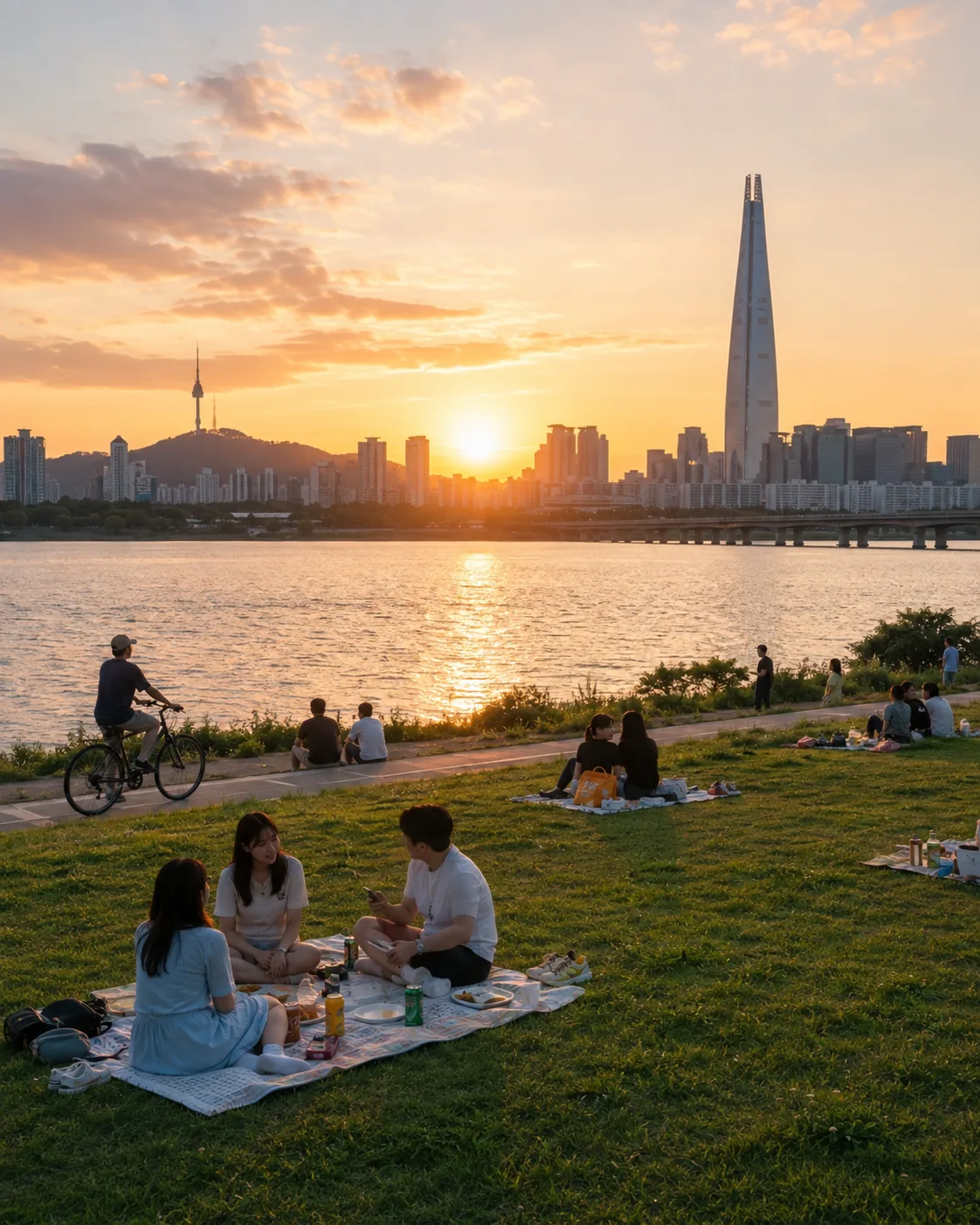
From convenience-store ramen to river buses and night views, Seoul’s ordinary way of unwinding has become a K-lifestyle experience visitors want to join.
For the Few Minutes It Takes the Ramen to Boil, a Visitor Becomes Part of Seoul
A first-time visitor arrives at Yeouido Hangang Park just before sunset.
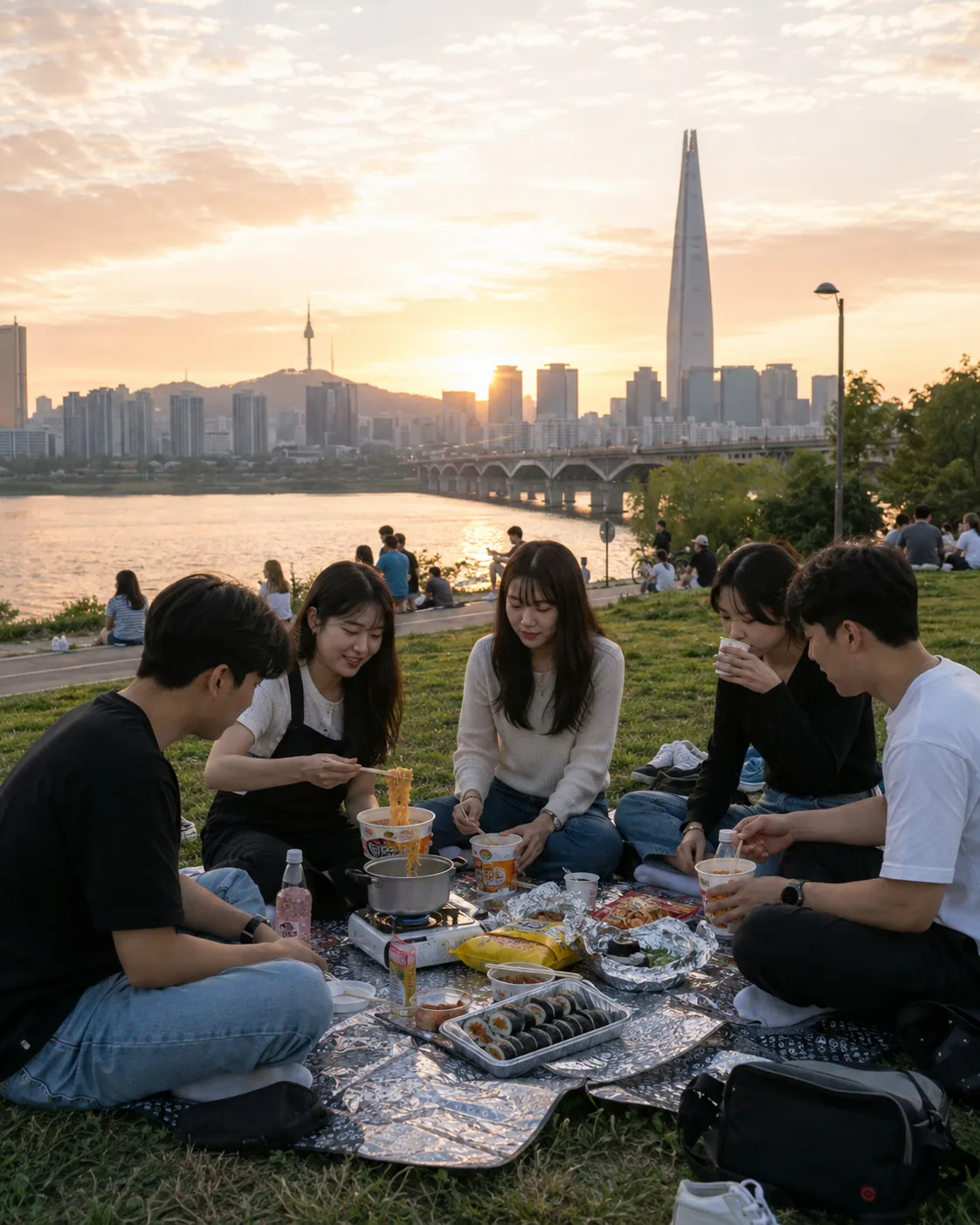
She has seen the scene before: foil bowls, convenience-store ramen, picnic mats, and the river glowing behind the skyline. Online, it looked effortless. In person, she spends several minutes comparing packets, translating labels on her phone, and watching the person beside her use the automatic cooker first.
Water pours into the bowl. The broth begins to bubble. She waits with office workers, students, couples, and other travelers doing the same thing.
Nothing about the moment is exclusive. That is the point.
At a palace, she looks into Seoul’s history. From an observatory, she looks down at the city. Here, she copies the way the city rests.
She carries the ramen toward the grass, finds a place between two groups of friends, and sits down as the light begins to soften. For the first time that day, she is not moving toward the next attraction.
She is simply staying.
AT A GLANCE
What It Is
A network of riverside parks where food, rest, exercise, transport, festivals, and everyday city life overlap.
What It Isn’t
A single, polished tourist district that delivers the same experience in every park, season, or time slot.
What Visitors Value
Affordable food, sunsets, open space, cycling, long unstructured stays, and the feeling of joining a local routine.
What Can Change the Experience
Weather, river wind, weekend crowds, festival schedules, park access, and how far the nearest convenience store or station actually feels on foot.
The River Became Seoul’s Front Yard
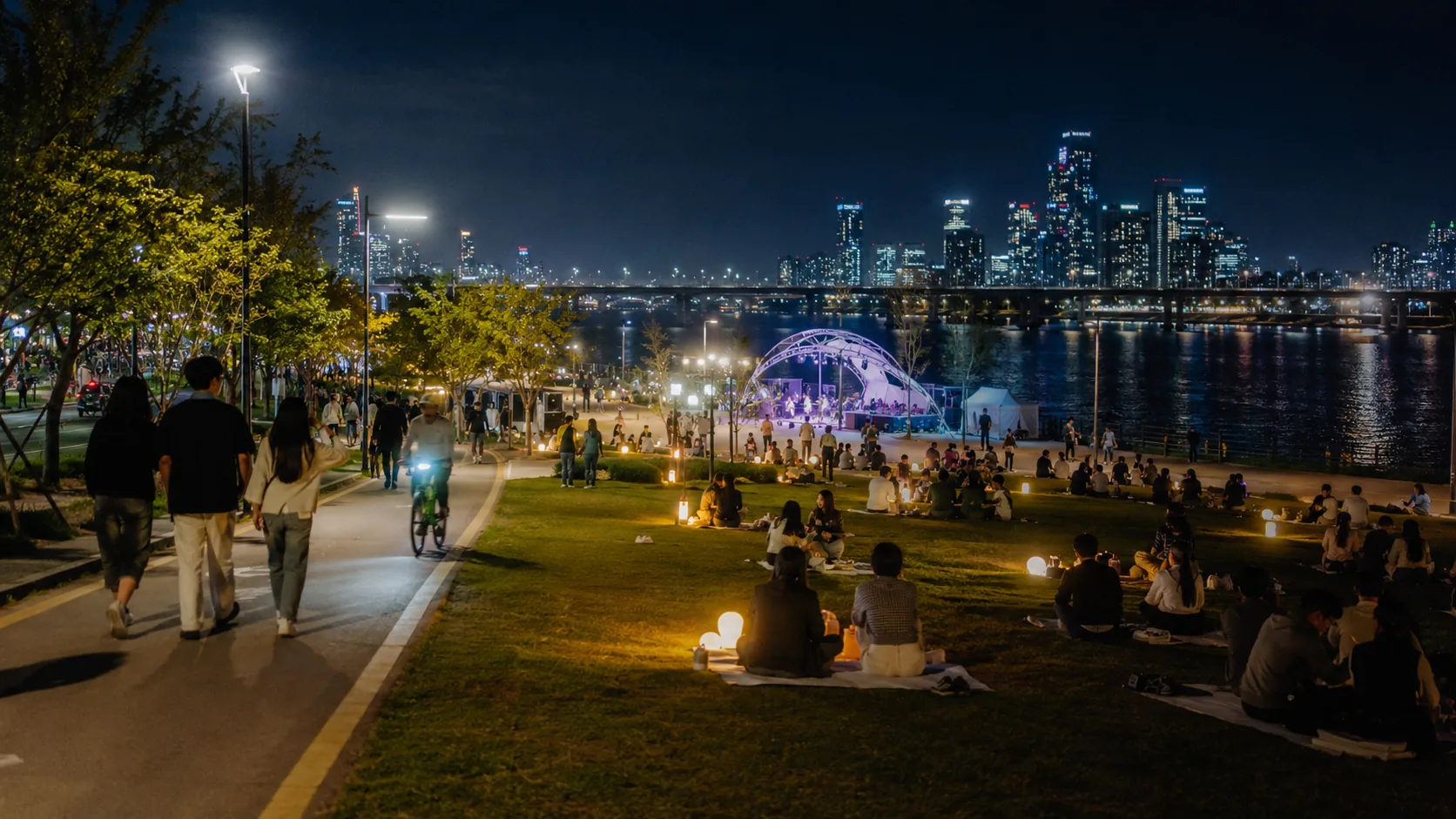
The visitor looking across the lawn sees a city using the river in many small ways at once.
A cyclist passes behind her. A family opens containers of food. Two friends take turns photographing each other against the sunset. Farther down the grass, someone is reading alone.
That casual mix did not appear by accident.
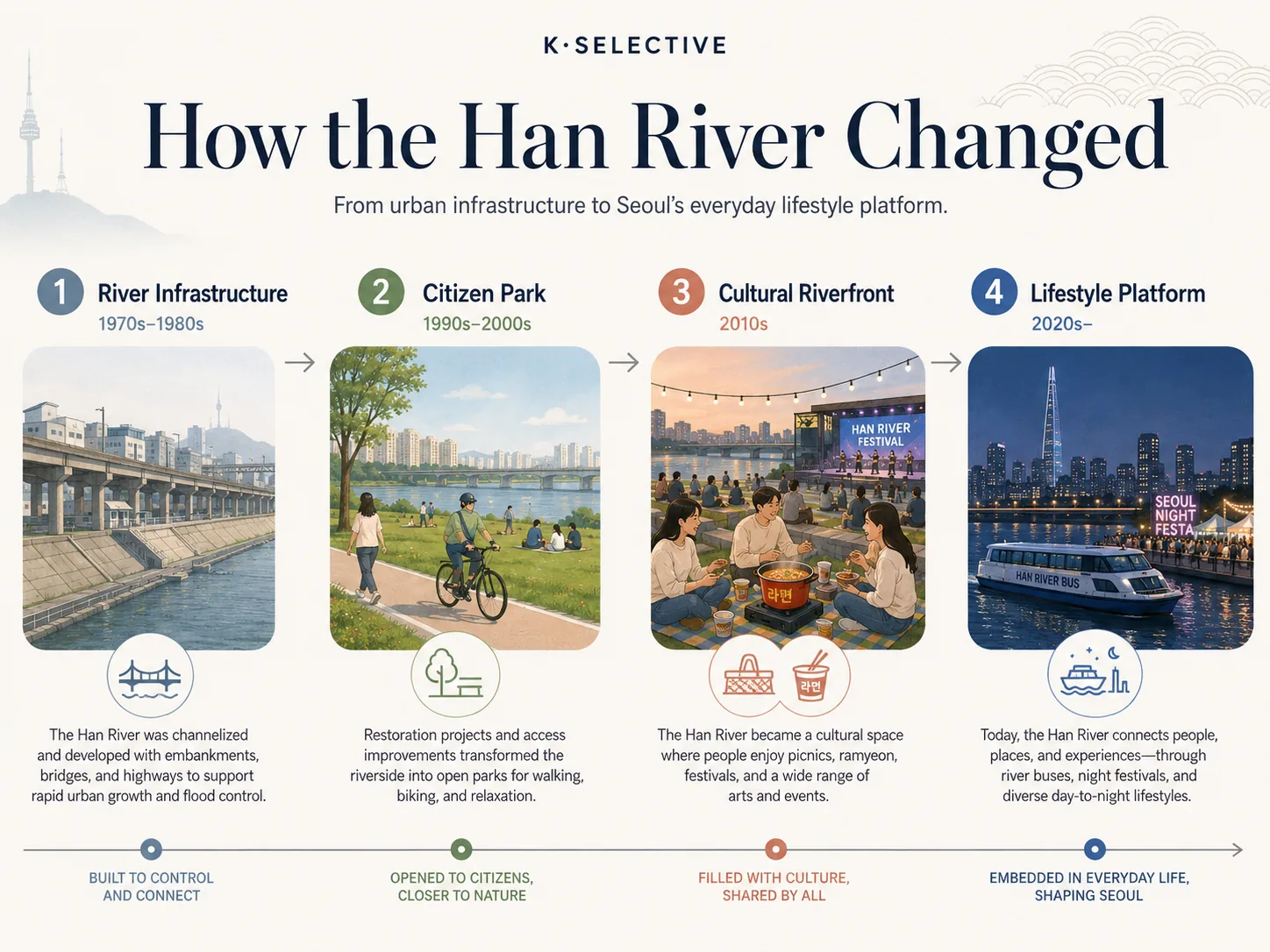
For much of modern Seoul’s history, the Han River was treated first as infrastructure: something to control, cross, and develop around. The large-scale river projects of the 1980s strengthened flood control and reshaped the riverbanks. Public lawns, sports facilities, bicycle paths, and recreational areas followed. In the 1990s, the city formalized the network now known as Hangang Park.
Later projects added ecological restoration, cultural spaces, better access, and seasonal programs. The river gradually moved through several roles: infrastructure, public park, cultural waterfront, and finally a platform woven into everyday urban life.
The result is not one attraction but several versions of Seoul sharing the same river.
Hangang Ramen Is Less a Dish Than a Way of Taking Part
By the time the visitor lifts the lid from her bowl, the ramen has absorbed the setting around it.
The noodles are ordinary. The experience is not.
She chose the packet herself, figured out the cooker, waited for the water to boil, and carried the bowl outside. The meal now includes the river wind, the sunset, and the people sitting nearby.
This is why “Hangang ramen” travels so well on social media. It is easy to understand and easy to repeat. No reservation is required. No specialist knowledge is needed. A visitor can enter the ritual within minutes.
Travelers often remember the context more vividly than the brand: the first attempt at using the machine, the steam rising in the evening air, the awkward search for a good patch of grass, and the satisfaction of eating something simple in a place that feels unmistakably Seoul.
The ramen industry has noticed. Instant-cooking machines and riverside ramen experiences have become visible parts of the way Korean ramen is marketed. Brands have also opened themed spaces near Hangang Bus piers, placing products directly inside the visitor’s memory of the river.
The product matters. The place completes it.
The Best Part Is Also the Hardest Part to Control
The visitor’s evening changes as the park fills.
What looked spacious an hour earlier now feels crowded. More picnic mats appear. Delivery riders move between designated pickup areas. Music from one group overlaps with another. The river breeze becomes colder after sunset.
This is where the online image and the real experience begin to separate.
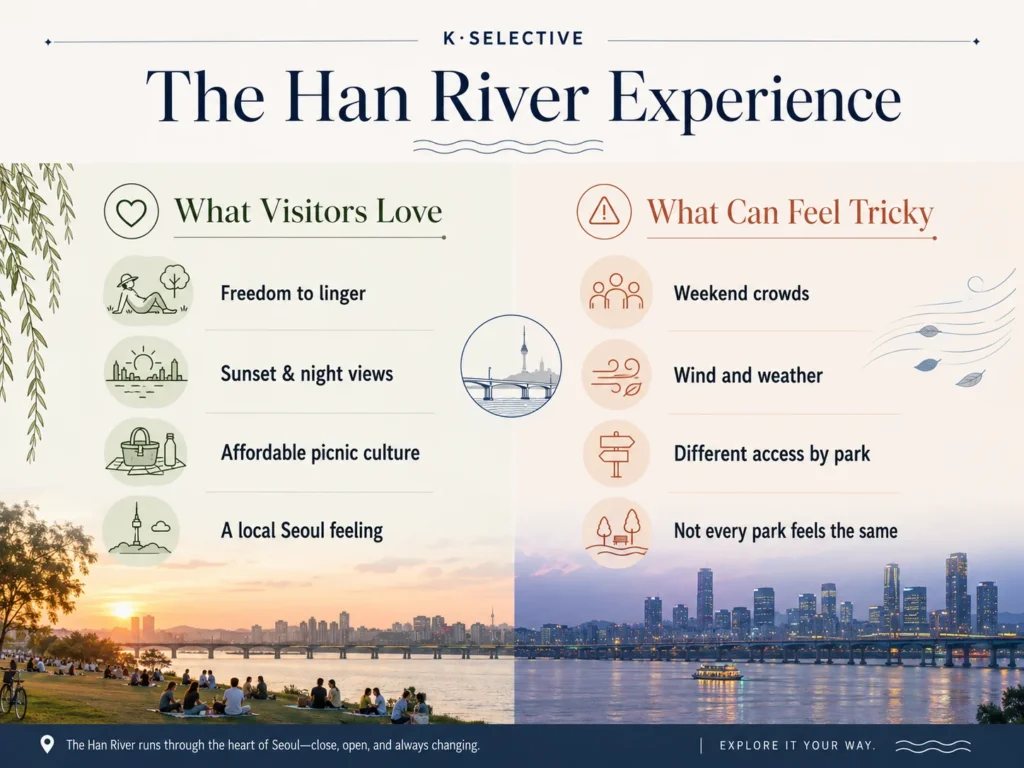
Travel discussions about the Han River often praise the same things: the freedom to stay, the low cost, the sunset, the bike paths, and the feeling of sharing ordinary city life. Yet those conversations also repeat the same warnings.
Yeouido and Banpo can become intensely crowded on weekends and event nights. River wind can make a mild day feel surprisingly cold. Rain or poor visibility can turn a carefully planned visit into an underwhelming stop. Quieter parks may offer more space but require longer walks, more preparation, or fewer nearby facilities.
These are not side notes to the experience. They are part of it.
The river feels authentic because it does not behave like a controlled attraction. The same openness that creates freedom also exposes visitors to weather, distance, noise, and other people.
One River, Four Different Evenings
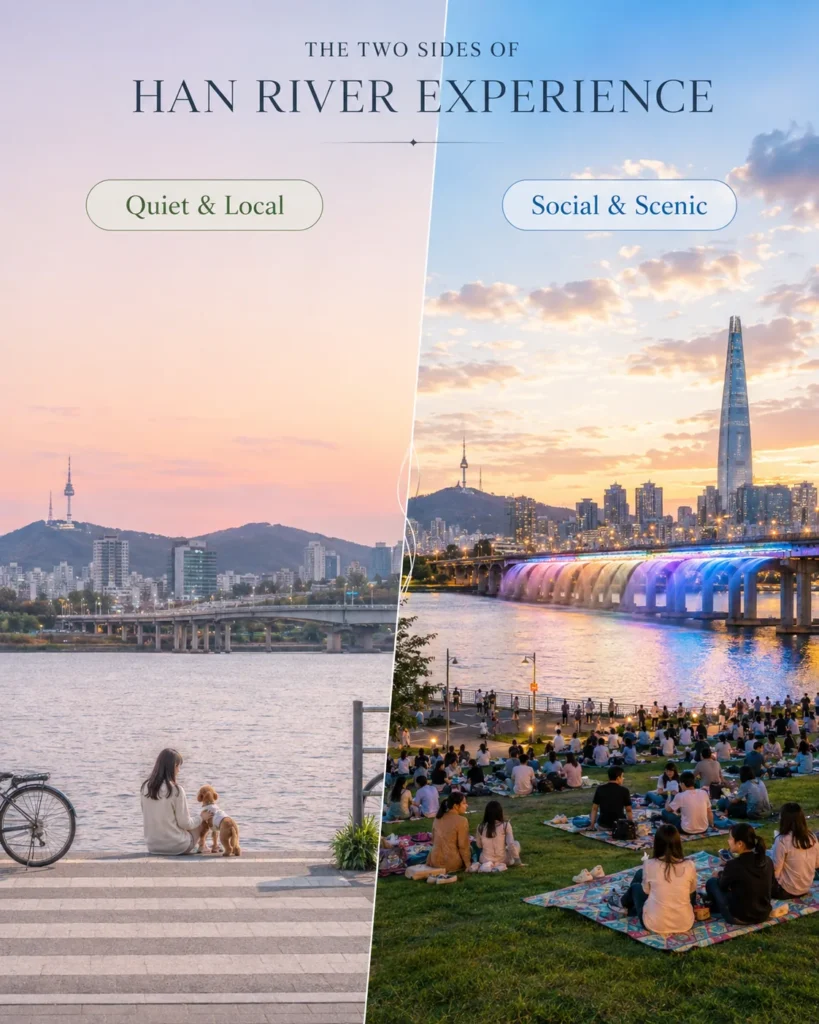
The visitor first assumed that “the Han River” meant one destination. It does not.
Each park changes the mood of the experience.
Yeouido Hangang Park — The Classic First Visit
Yeouido offers wide lawns, strong transport access, convenience stores, and the easiest version of the picnic experience most visitors recognize online. It is also one of the first places to feel crowded when the weather is good.
Banpo Hangang Park — Night Views with an Audience
Banpo is the more theatrical choice. Jamsu Bridge, the Moonlight Rainbow Fountain, night programs, and major events give the park a clear evening identity. The same features also attract large crowds.
Ttukseom Hangang Park — Active and Social
Ttukseom works well for visitors who want more than a picnic. Cycling, water activities, swimming, cultural programs, and large seasonal events make it one of the river’s most active zones.
Mangwon Hangang Park — The River as Part of the Neighborhood
Mangwon feels strongest when combined with the surrounding streets and market. Visitors can buy food in the neighborhood, walk toward the river, and let the picnic feel like an extension of local life rather than a separate sightseeing stop.
No park represents the entire Han River. The right choice depends on what kind of evening a visitor wants.
The River Now Moves, Performs, and Stays Open After Dark
After finishing her ramen, the visitor walks toward the water and notices how many layers now sit on top of the original park.
The river is no longer only a place to stop.
The Hangang Bus has added movement to the experience. After safety reviews and route improvements, full-route service resumed in 2026, connecting riverside districts through a journey designed to feel more scenic and spacious than the subway. Panoramic windows, tables, bicycle storage, and onboard refreshments turn the ride into something between public transport and a moving lounge.
For commuters, the service still has to prove its efficiency. For visitors, its appeal is easier to understand: the journey itself becomes part of Seoul.
Night programs add another layer. Seasonal festivals, silent DJ events, films, performances, pedestrian programs, and drone shows extend the river well beyond daytime recreation. One person may arrive for a scheduled event. Another may cycle past and stop for ten minutes. A third may sit farther away and listen from the grass.
Participation remains loose.
That low threshold is one of the Han River’s strongest qualities. People can join the city without needing to understand every program or buy an expensive ticket.
✓
What This Experience Is
The Han River is a shared urban environment where people build their own visit through small actions: choosing food, sitting on the grass, cycling, watching the sunset, joining an event, or crossing the city by boat.
The memory depends less on one landmark than on how the time was spent.
×
WHAT IT ISN’T
It is not one uniform attraction with guaranteed views, easy access, and a fixed program
A good visit depends on the park, season, time of day, weather, and crowd level. Arriving at “the Han River” is only the beginning of the choice.
AUDIENCE FIT
Who This Experience Suits
The Han River works especially well for travelers who enjoy unstructured time, local routines, affordable food, walking, cycling, sunsets, and public spaces that feel lived in rather than staged.
THINK TWICE IF
You Expect Fast, Corrective Results
It may disappoint travelers who need a clear attraction sequence, dislike weather exposure or crowds, have very limited time, or expect every park to sit directly beside a subway exit and convenience store.
Review method and limitations
K-SELECTIVE separates brand positioning, recurring consumer-review themes, retail signals, and editorial interpretation. Review counts and ratings can change over time, and individual skincare responses vary. The review-signal chart summarizes editorial coding of the available review sample and should not be read as a clinical measurement or a full statistical coding of every review.
K-SELECTIVE VERDICT
SELECTED — “must-see”
It does not offer a perfect version of Seoul. It offers access to an ordinary one.
The crowds, wind, uneven access, and changing conditions can make the experience less convenient than it appears online. Yet those same imperfections keep it from feeling like a set built only for tourists.
The Han River is best understood not as a landmark to complete, but as a piece of Seoul life to enter for a few hours.
Place Information
Place
SEOUL
RANGE
Han River accross Seoul
CATEGORY
Life Style
LAST CHECKED
25 July 2026
SOURCES
- Seoul Metropolitan Government — Hangang Parks
- Seoul Metropolitan Government — Hangang Bus policy and 2026 route updates
- Seoul Metropolitan Government — 2026 Hangang River Festival and Jamsugyo programs
- Korea Tourism Organization / Visit Seoul — Official park information
- Nongshim and Ottogi — Official riverside ramen-store announcements
- Reddit communities
r/koreatravelandr/seoul— Visitor discussions on picnics, crowds, weather, cycling, and park accessAL — Official Product Information - K-SELECTIVE — Field Reference
RELATED
- Insight — From 10 Steps to 3: What K-Beauty’s Routine Shift Reveals
- K-Signal — Sheet masks as routine-maintenance products
- Method — About / How We Select
Leave a Reply