
A fandom object built for identity, participation and synchronized spectacle found a new role in South Korea’s public life
At a K-pop concert, the audience does not disappear when the stage lights come on. Thousands of fans raise artist-specific light sticks. Colors move across the arena, waves travel from section to section and the crowd becomes part of the visual production. Each person holds an individual object, but the full image only appears when everyone joins in. Official concert systems now pair many light sticks with seat information and coordinate their colors and timing across an entire venue.
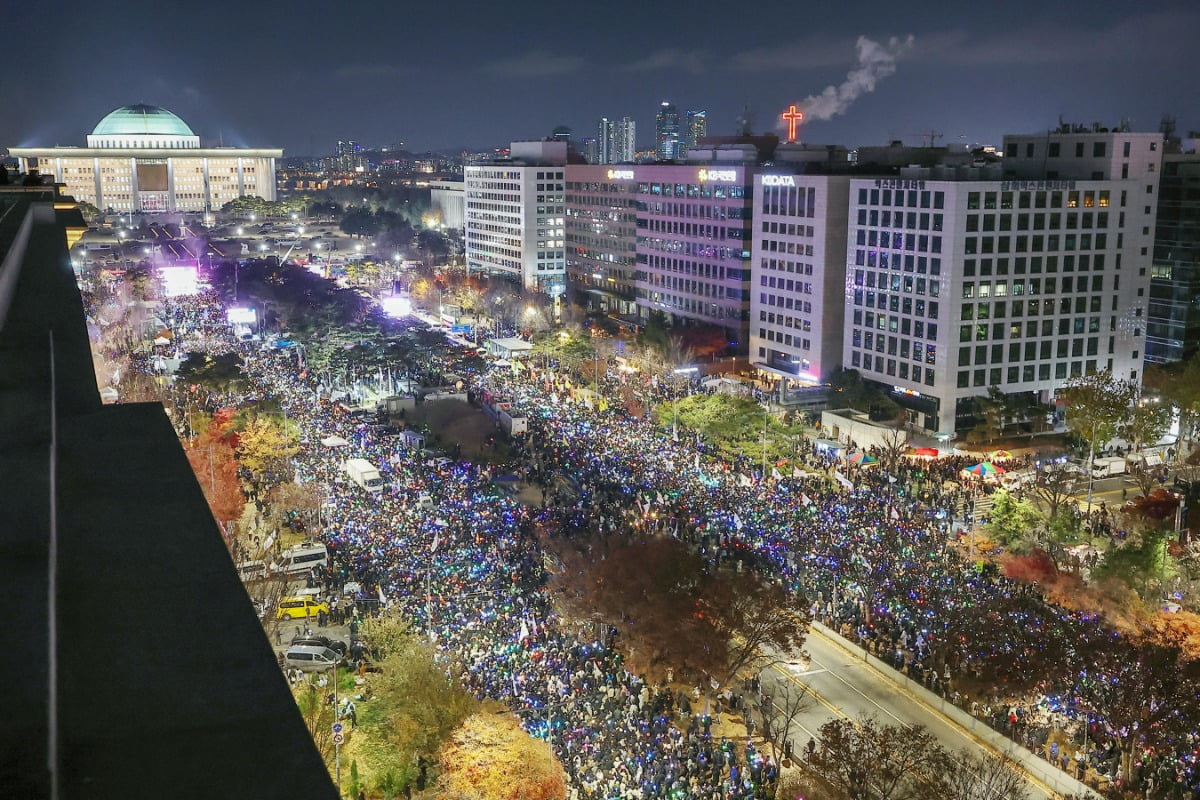
In December 2024, that familiar object entered a radically different setting. After President Yoon Suk Yeol declared martial law on December 3, citizens gathered outside the National Assembly and across Seoul. They carried light sticks made for BTS, NCT, ATEEZ, PLAVE and many other artists, sang K-pop songs and turned fan chants into demands for impeachment. Reuters and the Associated Press documented younger demonstrators waving the devices through near-freezing nights as the protest movement grew.
Manufacturers did not give the devices a political purpose. Citizens changed their meaning by carrying the habits of fandom—coordination, visible belonging, endurance and care—into public life.
This is the signal: a commercial object created to connect artist and fan became a portable language through which citizens could find one another.
Before the Light Stick, Fandom Had a Color
Korean fan culture developed a visual language long before Bluetooth apps and programmable LEDs. During the first-generation idol era of the 1990s, fandoms filled venues with colored balloons. H.O.T. fans claimed white, Sechs Kies fans yellow, g.o.d fans sky blue and Shinhwa fans orange. A single color could identify a community from across a stadium.
That system also created pressure. As more artists debuted, the available palette grew crowded, and similar colors could blur the boundaries that fans wanted to protect. Entertainment companies and fans gradually moved from color alone toward objects that combined color, shape, logo, name and story. The National Folk Museum of Korea now treats the light stick as a representative object through which people can understand the formation and meaning of Korean fandom culture.
Industry histories often credit Se7en’s number-seven-shaped Chilbong as an early break from the generic glow-stick form. BIGBANG’s crown-shaped Bangbong then helped establish the three-dimensional, artist-specific model that now defines the category. These origin stories still contain disputed dates and competing claims, so the larger transition matters more than a single claim to “first”: fandom identity moved from a shared color to a designed object.
An official light stick now answers a basic question: how can a dispersed crowd show that it belongs together? Its form often reflects an artist’s logo, fandom name or visual world. Fans collect it, decorate it and carry it across borders. Before two strangers exchange a word, the object can signal a shared affiliation.
The light stick therefore does more than advertise loyalty. It turns an otherwise private attachment into a visible social relationship. The fan can say, without speaking, “I am here.” Thousands of fans can answer at once.
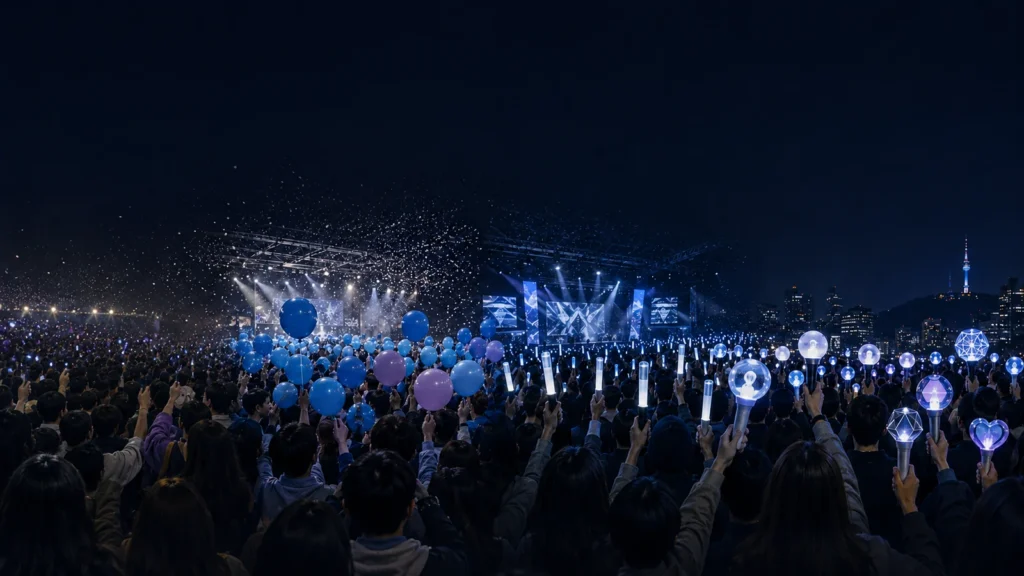
Korean fandom identity evolved from shared colors into distinctive objects shaped by design, technology and collective participation.When the Audience Became Part of the Show
Modern light sticks also function as performance technology. Many official models connect to a mobile app through Bluetooth. Fans enter their seat information before a concert, and the production system coordinates color and timing across the venue. Official user guides instruct fans to pair the device with a seat, update its firmware, prepare fresh batteries and activate concert mode before the show.
This system changes the usual boundary between stage and audience. Fans do not simply watch a finished spectacle. Their synchronized participation completes it. Each device acts like a pixel, and the arena becomes a screen made of people.
That experience teaches a repeatable grammar of participation. Fans learn chants, follow cues, share instructions, arrive prepared and coordinate with strangers. They also learn how to keep an individual identity visible inside a much larger collective pattern. Research on K-pop’s platform-based fandom culture describes fans as active participants who continually negotiate relationships with artists, companies and one another rather than merely consuming finished content.
Recent scholarship gives this process a useful analytical frame. A 2026 study examined 2,218 narrative statements from 118 Korean K-pop fans and found that sensory experiences involving sound, rhythm, light and collective immersion could develop into responsibility, solidarity, donation, boycott and participation in demonstrations. The author describes fandom as an “affective infrastructure” through which shared feeling can acquire civic meaning.
A separate 2025 study of the anti-martial-law protests argues that women in their twenties and thirties became a central node in new forms of solidarity that connected queer citizens, people with disabilities, precarious workers, farmers and other groups. The study does not claim that K-pop automatically created those alliances. It shows how familiar cultural practices helped participants recognize and communicate with one another.
A concert does not train people to support one political position. It can, however, make large-scale participation feel familiar.
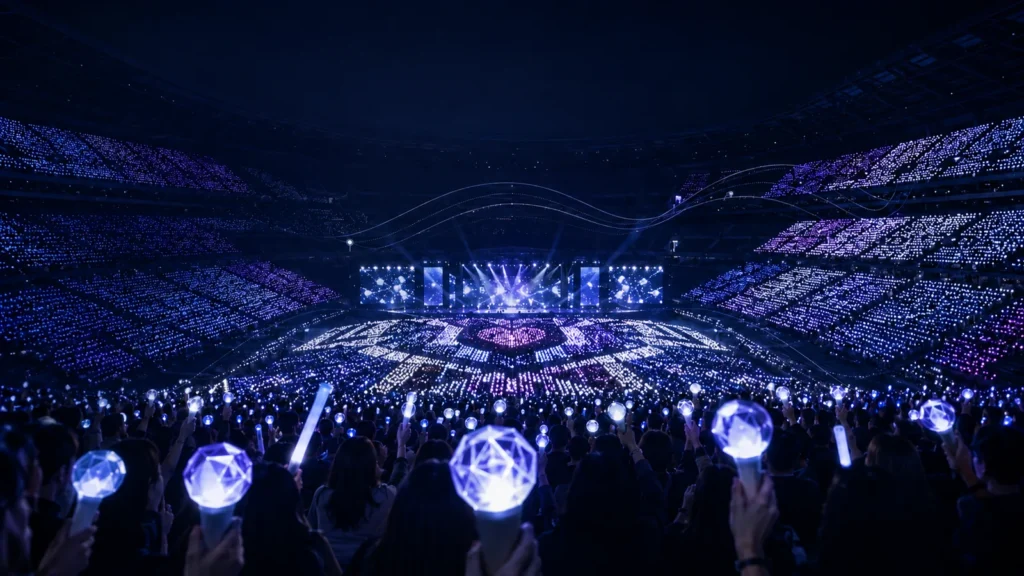
Connected light-stick systems turn individual audience members into part of a coordinated visual performance.The Night the Fandom Ocean Entered the Square
Candles already held a deep place in South Korea’s protest culture. They became the defining image of the 2016–2017 movement that led to President Park Geun-hye’s removal. The light sticks of 2024 did not erase that history. They extended its visual language for another generation.
Yoon declared martial law late on December 3, 2024. The National Assembly voted to demand its removal less than three hours later, with all 190 lawmakers present supporting the resolution. Yoon withdrew the decree after the parliamentary vote, ending the measure after roughly six hours.
Protesters then gathered in freezing weather to demand his impeachment. Reuters documented crowds outside the National Assembly waving artist-specific light sticks and chanting political slogans to tracks such as aespa’s “Whiplash.” The National Assembly impeached Yoon on December 14. On April 4, 2025, the Constitutional Court unanimously upheld the impeachment and removed him from office.
The square presented a striking contrast with the concert hall. In an arena, one artist’s light stick organizes one fandom. In Yeouido and central Seoul, many fandoms stood together. Their colors and shapes remained distinct, but those differences no longer divided the crowd. They showed how people could keep separate cultural identities while acting around a shared civic demand. Photographs from the demonstrations captured dozens of differently shaped devices glowing together rather than forming one uniform block of color.
The devices also offered practical advantages. They shone brightly, resisted the wind and fit easily in one hand. More importantly, many younger participants already knew how to use them. Familiar music, call-and-response chants and fan-made signs reduced the emotional distance between everyday cultural life and a political gathering.
Reuters interviewed protesters who said K-pop and light sticks lowered the barrier to joining a rally. One participant compared the political chants directly with slogans that fans use to support idols at concerts. Journalists also noted the strong presence of young women, who stood at the center of a protest culture that combined political urgency with humor, music, food and visual creativity.
The atmosphere could look colorful, musical and even joyful without weakening the seriousness of the demand. Joy helped people remain in the cold, return to the streets and imagine themselves as part of a public. Research on the 2016–2017 candlelight movement had already identified entertaining and carnivalesque experiences alongside reflection and solidarity; the light-stick rallies developed that participatory tradition through a newer cultural vocabulary.
Celebration did not cancel dissent. It helped sustain it.
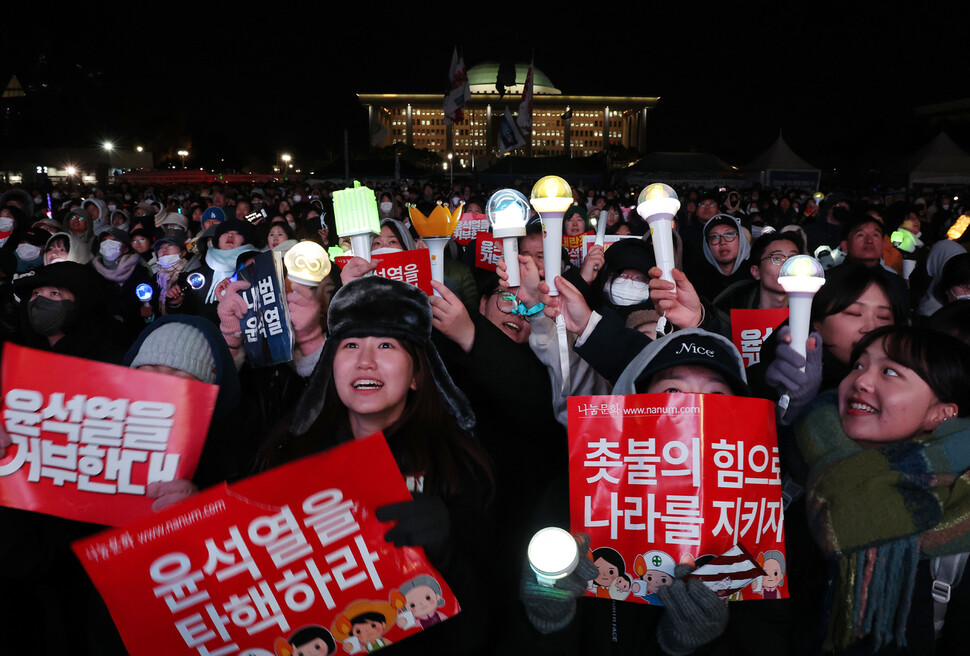
Different fandom identities remained visible while participants gathered around a shared civic demand.Fandom Skills Became Civic Infrastructure
The most important transfer did not involve the plastic device itself. It involved the practices around it.
K-pop fandoms routinely organize across distance. Fans translate information, manage schedules, coordinate voting, raise funds, prepare banners, distribute goods and build networks on digital platforms. Academic studies have documented fan-generated translation, charitable fundraising, volunteering and social activism, while also warning that the same organizational power can support exclusion or online vigilantism.
In the 2024–2025 protests, citizens redirected those habits toward civic goals. Social media circulated playlists, rally information and messages encouraging people to bring light sticks. Participants lent devices, borrowed them from family members, carried inexpensive LED alternatives and created flags for humorous or imagined associations. These flags gave individuals a way to announce who they were and find companions without joining a conventional organization.
This form of organization rarely follows a single command center. Small actions accumulate, spread through networks and create practical support at scale. The resulting infrastructure looks informal, but it can still move information, emotion and material care quickly. Research on fandom activism in Korea and other countries similarly finds that fans can transfer digital fluency, fundraising practices and collective emotion from entertainment spaces into social movements.
The change also challenged an old hierarchy of seriousness. Public commentary has often treated female-dominated fandom as excessive, irrational or trivial. The rallies showed that the same communities could carry organizational knowledge, visual creativity and mutual care into a constitutional crisis. Scholarship on the demonstrations interprets young women’s participation not as a decorative addition to the protests but as an important source of new political subjectivity and intersectional solidarity.
The light stick did not give anyone a political voice. It made voices that already existed easier to recognize, join and amplify.
A Democratic Symbol with Commercial Limits
The light stick gained democratic meaning through use, not through design. The product itself has no fixed ideology. Different people can carry the same object toward different political claims, and no entertainment company controls every meaning that fans attach to it. Later reporting on South Korea’s political crisis showed that citizens on competing sides could repurpose familiar consumer objects as political tools, which underlines the absence of any permanent ideology inside the object itself.
That flexibility makes the symbol powerful, but it also requires caution. K-pop did not create South Korean democracy, and light sticks did not replace political parties, labor unions, civic groups, journalists, lawyers or lawmakers. Korea’s democratic movements draw on a much longer history of protest and resistance, while organized labor and political groups also played major roles in the 2024 demonstrations.
The object also carries commercial limits. Official light sticks often cost tens of thousands of won. They depend on company-owned designs, batteries, electronics and plastic, and companies may release new versions that require fresh purchases or firmware support. Official guides commonly require three alkaline batteries, while reporting on the protests raised concerns about both cost and environmental waste.
Those features can turn visible belonging into a question of purchasing power. A fan who cannot afford an official device may feel less visible at a concert, while repeated product versions can intensify the environmental burden of fandom consumption.
Yet the rallies also loosened the link between ownership and legitimacy. People borrowed devices, brought inexpensive LEDs, carried candles or arrived with no light at all. Reports described parents using their children’s light sticks and fans lending or donating devices to others. The square did not require an official product. It invited people to use whatever helped them appear together.
A civic symbol remains democratic only when participation stays more important than the merchandise.
What the Light Stick Reveals About Contemporary Korea
The history of the light stick follows four linked changes. Fandom moved from color to designed identity. The cheering tool became connected performance technology. Private attachment gained a portable public form. Finally, concert practices entered civic space. Evidence from museum documentation, official concert guides, protest reporting and recent scholarship supports this sequence, although no single moment or product caused the entire transition.
These changes do not prove that popular culture naturally produces democracy. They show something narrower and more useful: popular culture can give people familiar methods for entering public life.
A fan already knows how to stand among strangers, follow a shared rhythm and make support visible. A fandom already knows how to circulate information, organize care and sustain attention. When a political crisis arrives, citizens can redirect those skills toward a different object of commitment. Research on the Korean demonstrations and K-pop activism elsewhere supports this interpretation of transferable practices rather than automatic political conversion.
The 2024–2025 light-stick protests also complicate the idea that solidarity requires sameness. BTS purple, NCT green and dozens of other colors did not merge into one neutral symbol. The crowd kept its differences visible. Solidarity emerged through coordination among those differences. Photographic reporting and subsequent academic analysis both emphasize this coexistence of distinct identities within a shared demand.
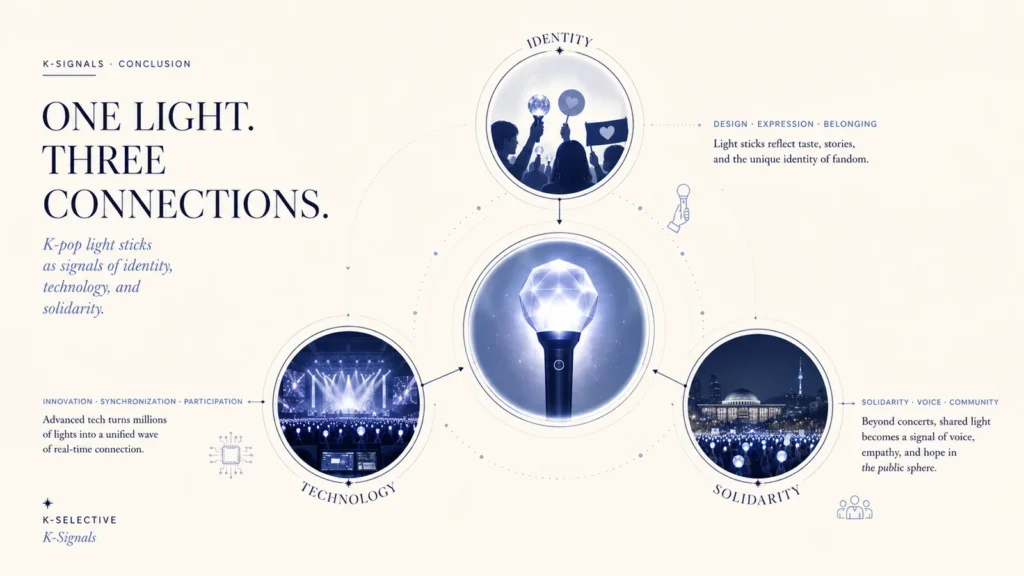
The light stick connects three signals: designed identity, synchronized technology and solidarity across difference.That is why the K-pop light stick belongs in K-Signals.
It is not only an iconic piece of Korean merchandise. It shows how design, technology and collective practice can travel beyond their original setting—and how citizens can assign a commercial object a public meaning that its creators never planned.
The light was built for a concert. The square taught it another language.

Sources
- National Folk Museum of Korea, Encyclopedia of Korean Folk Culture — “Light Stick”
- Reuters — “K-pop light sticks fire up Yoon’s impeachment protests in South Korea”
- Seoul I2026 research on sensory fandom experience and civic actions Fashionable
- research: The History of K-pop Light Sticks and Their Democratic Symbolism
- “It Doesn’t Go Out in the Wind”: The Power of K-pop Light Sticks Beyond Concert Halls
- Research on digital organization, translation, charity and activism in K-pop fandoms
- Constitutional Court of Korea — Case on the Impeachment Trial of President Yoon Suk Yeol
Leave a Reply