

Why Korea’s most ordinary household-goods store feels extraordinary to visitors—and what that gap reveals about everyday life.

A foreign visitor walks into a Daiso in Korea and checks the price of a ₩1,000 item.
A little later, another price draws a stronger reaction:
“Unbelievably cheap.”
Then the surprise changes.
“You even get a shovel.”
The shovel matters because the reaction is no longer only about price. The visitor has started discovering the logic of the store itself: one aisle leads to another, and each one seems to contain something that was never on the shopping list.
By the end, the verdict returns to the first impression:
“The price was super friendly.”
The auto-generated transcript from this short video misreads some numbers and currency units, so it is not reliable enough for exact price comparisons. But the sequence is clear: price shock → unexpected products → surprise at the store as a whole.
The same pattern appears across travel videos and public visitor discussions about Daiso Korea. People compare prices with home, add items they never planned to buy, and joke about receipts that seem absurdly long. The Korea Tourism Organization now features Daiso in shopping content for international visitors, reflecting how an ordinary household-goods chain has become part of the Korea travel circuit.
That leaves a more interesting question.
The United States has discount stores. Japan has 100-yen shops. Daiso itself is not an unfamiliar name internationally.
So why can an ordinary Korean household-goods store feel like a distinctly Korean experience?
The answer is not simply that Daiso is cheap or has a lot of products. The more revealing gap is this: many of the conditions visitors find remarkable are already treated by Koreans as part of the normal retail environment.
Following that gap tells us something about what everyday life in Korea has come to expect.
Key Insights

PRICE SHOCK
Price opens the door.
The store keeps people inside.
Low prices often create the first moment of surprise. But as visitors keep browsing, attention moves from the price tag to the range of products and the pleasure of finding something unexpected. The attraction is less about one hero item than how the entire store works.

STORE DISCOVERY
Daiso turns small needs into easy options.
Six fixed price points, roughly 30,000 products, around 600 new products a month, and a wide store network make small household needs feel unusually easy to address.

KOREAN BASELINE
The biggest contrast is not foreign vs. korean taste. it is expectation
Visitors may be surprised that this retail environment exists at all. Korean shoppers already expect it to exist, then discover new things inside it. They may stand in front of the same shelves, but they begin from different baselines.

They Enter for the Price. They Stay for the Store.
Price remains the strongest entry point.
Asung Daiso currently maintains six fixed price points: ₩500, ₩1,000, ₩1,500, ₩2,000, ₩3,000 and ₩5,000. Its customer promise also emphasizes store accessibility, product development and quality control alongside price.
For a foreign visitor, those numbers are not just won amounts.
People already carry an internal sense of what socks, storage boxes, stationery or kitchen tools usually cost at home. Seeing an everyday object priced at ₩1,000 or ₩3,000 immediately triggers comparison.
But low prices alone do not explain what happens next.
Daiso Korea carries roughly 30,000 products. According to Asung Solution, about half are ₩1,000 items, and around 600 new products are introduced each month.
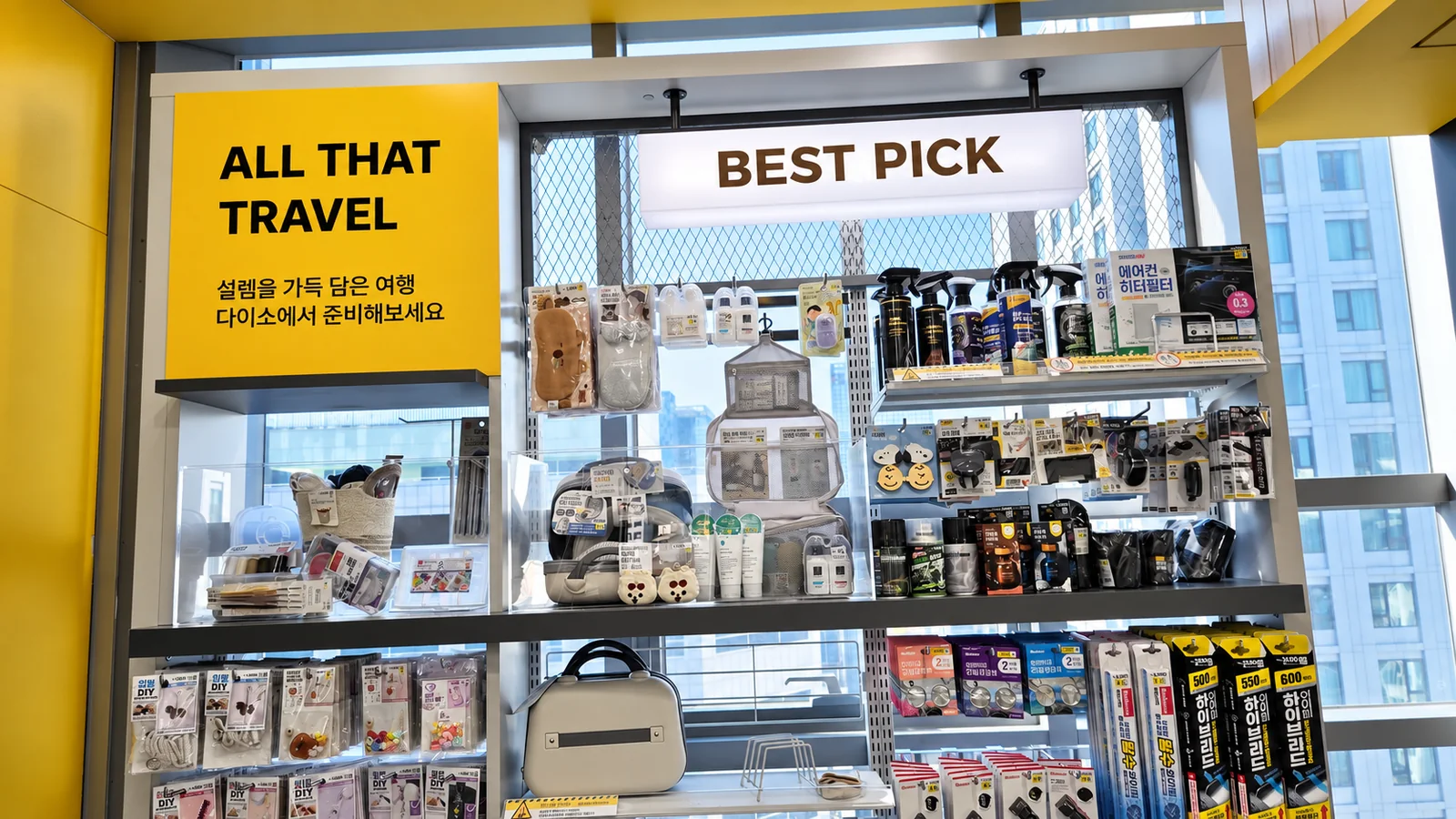
A shopper can move from kitchen tools to stationery, from stationery to character goods, then through travel accessories, electronics accessories and household tools they never expected to see.
At that point, the shopping question changes.
From “How much is this?” to “What else is in here?”
Price starts the exploration. Range and constant refresh keep it going.

They Enter for the Price. They Stay for the Store.
Price remains the strongest entry point.
Asung Daiso currently maintains six fixed price points: ₩500, ₩1,000, ₩1,500, ₩2,000, ₩3,000 and ₩5,000. Its customer promise also emphasizes store accessibility, product development and quality control alongside price.
For a foreign visitor, those numbers are not just won amounts.
People already carry an internal sense of what socks, storage boxes, stationery or kitchen tools usually cost at home. Seeing an everyday object priced at ₩1,000 or ₩3,000 immediately triggers comparison.
But low prices alone do not explain what happens next.
Daiso Korea carries roughly 30,000 products. According to Asung Solution, about half are ₩1,000 items, and around 600 new products are introduced each month.
A shopper can move from kitchen tools to stationery, from stationery to character goods, then through travel accessories, electronics accessories and household tools they never expected to see.
At that point, the shopping question changes.
From “How much is this?” to “What else is in here?”
Price starts the exploration. Range and constant refresh keep it going.

Korea Is Not the Only Place With Cheap Stores. The Difference Is What Comes Together
Stores that are cheap and full of products are not unique to Korea.
That is why explaining Daiso as proof that “things are cheap in Korea” misses the point. Korea is not universally inexpensive. Accommodation, dining, housing and consumer goods do not all fit a low-price story.
What visitors encounter at Daiso is a combination of conditions.
The price range is broadly predictable.
The product range reaches deeply into everyday life.
New items appear constantly.
Practical household goods sit next to character collaborations, stationery and seasonal products.
And stores are found not only in tourist districts but throughout ordinary Korean neighborhoods.
In 2025, Asung Daiso reported ₩4.5363 trillion in revenue and ₩442.4 billion in operating profit. Its store count surpassed 1,600 locations nationwide.
Those figures do more than show a large company. They provide scale for something more culturally relevant: this way of shopping is no longer a niche habit in Korea.
Daiso now resists a single retail identity.
It is a place for necessities,
a place for discovery,
a place to save money,
and a place to add a small pleasure.
Need and discovery move through the same space.
The Same Store Looks Different Through Korean Eyes
Now shift the viewpoint.
A foreign visitor’s reaction can often be condensed into one question:
“They sell this too?”
A more familiar Korean reaction runs in the opposite direction:
“Maybe Daiso has it.”
The Korean phrase—“Daiso gamyeon itji aneulkka?”—is not a line from a formal consumer survey. It is useful as editorial shorthand for the store’s place in everyday Korean life.
Consumer data supports the broader point that Daiso is not tied to one age group or one category.
In University Tomorrow 20s Lab’s 2024 retail survey, 98.4% of respondents who had visited a household-goods store in the previous six months said they had visited Daiso. Gen Z respondents showed particularly strong interest in stationery and fancy goods, while older groups leaned more heavily toward cleaning, laundry, storage and organization products.
Korean shoppers also browse for discovery.
They look for new releases, character goods and products seen on social media. They also put unplanned items into their baskets.
So the contrast is not “foreigners discover, Koreans run errands.”
The difference is the level at which discovery begins.
Visitors discover that this kind of system exists. Koreans already know the system exists and discover new things inside it.

How Did This Become So Ordinary?
Daiso’s own brand story uses the phrase “Everyone’s Store.”
The phrase itself is marketing language. More useful is the role the company says it wants to perform: small goods needed for daily life, uniform pricing, convenient access and reliable quality.
None of those elements is remarkable on its own.
There are cheap stores.
There are stores with huge assortments.
There are convenient neighborhood retailers.
There are trend-driven stores that constantly introduce new products.
Daiso’s distinction comes from how those conditions have operated together, for years, inside the same retail environment.
Low prices reduce the amount of thought required for small purchases.
Nearby stores reduce the need for a dedicated shopping trip.
A broad assortment increases the chance that several small household problems can be addressed in one place.
Constant product turnover gives even routine shoppers a reason to browse.
Over time, this creates an expectation:
“If the problem is small, there is probably a low-cost way to fix it somewhere nearby.”
What Daiso reveals is how ordinary that expectation has become.

In Korea, Convenience Is Not Only About Speed
Korean convenience is often described through speed.
Fast delivery.
Dense public transport.
Late-night access to services.
In an earlier K-Signals story, K-SELECTIVE looked at Korean convenience stores as infrastructure that compresses time and fills small gaps in the day.
Daiso points to another kind of convenience.
A charging cable keeps falling behind the desk.
There is an awkward unused space in the bathroom.
A suitcase needs a better way to separate small items.
The refrigerator is always disorganized.
None of these problems changes a life. Most can simply be tolerated.
But when a possible fix is nearby and costs ₩1,000 or ₩2,000, the status of the inconvenience changes.
A problem that was “not worth fixing” becomes a problem there is little reason to keep tolerating.
Daiso is less a place that solves major problems than a place that attaches small products to hundreds of tiny frictions.
This suggests another definition of convenience:
not only getting something faster, but living with the expectation that a small problem should not require much money, planning or effort to solve.
The Other Side of Convenience: Fewer Reasons Not to Buy
Up to this point, Daiso can sound like a symbol of a highly convenient consumer environment.
K-Signals also has to look at the tension created by that convenience.
Low prices reduce purchase anxiety.
A huge assortment increases the number of available options.
Constant newness gives people a reason to browse.
Together, those conditions make necessary items easier to buy—but they can also make unnecessary purchases easier to justify.
“It’s only ₩1,000.”
“This is cute.”
“I might need it later.”
That is why jokes about the impossibly long Daiso receipt are more revealing than they first appear. The same store that reduces the friction of everyday problems also reduces the friction of the buying decision.
This tension exists for Korean shoppers too.
In the 20s Lab survey, stationery and fancy goods ranked first among Gen Z’s Daiso purchase categories. Today’s Daiso sits somewhere between a practical household-goods store and a low-cost discovery space for small expressions of taste.
It would be too simple to celebrate that as pure convenience.
It would also be too simple to dismiss it as cheap consumption.
The environment that makes needs easy to solve can be the same environment that makes small wants easy to add.
Do Tourists Really Want Daiso—or the Life Around It?
Return to the opening scene.
The visitor is surprised by ₩1,000 prices, discovers products that were never expected, keeps browsing, and reaches the checkout with more than originally planned.
Explaining that experience only as “Daiso is cheap in Korea” leaves something out. Korea is not a universally low-cost country, and Daiso does not promise the highest quality in every category.
If visitors leave wishing they had a place like this at home, perhaps the object of desire is larger than the sign above the entrance.
It is an environment where people can expect a solution to exist,
where trying one does not require a major purchase,
and where practical needs and small pleasures occupy the same everyday space.
Visitors see products, but they are also seeing one version of how Korean daily life is organized.
Koreans rarely describe that as culture.
They just wonder whether Daiso has what they need.
That ordinariness is exactly what makes the store a K-Signal.
The Next Signal: When Everyday Korean Retail Becomes a K-Experience
The next interesting question is not simply whether Daiso will open more stores or grow larger.
A more important shift is already happening: retail built for Korean daily life is becoming a place where visitors experience Korea.
Daiso was not created as a souvenir shop.
Yet visitors can move through yakgwa snacks, character goods, stationery, travel accessories, K-beauty and household products within a single store. The Korea Tourism Organization now treats Daiso itself as travel-shopping content rather than merely highlighting a premium Korean brand.
The question, then, may not be how many tourist-focused products Daiso should add.
If part of the attraction is that this is still an ordinary store for Koreans, how far can it become a tourist experience without losing that ordinariness?
The same question extends beyond Daiso.
Convenience stores, large pharmacies and other everyday retail spaces are increasingly becoming places where visitors encounter Korean life directly.
For years, K-content largely moved outward: Korea sent music, beauty, food and entertainment to the world.
Part of the next phase may move in the opposite direction.
Visitors come to Korea, use systems Koreans already consider ordinary, and return home remembering the experience.
Daiso is one of the clearest places to watch that shift.

The Signal
DAISO — WHEN SMALL FRICTIONS BECOME A RETAIL SYSTEM
The most important signal at Daiso is not the low price, or even its popularity with tourists.
It is the way very small inconveniences have become problems with readily available product solutions.
A cable will not stay in place. Refrigerator space is awkward. Small items get mixed inside a suitcase. These are problems people can live with.
But expectations change when several possible fixes are nearby and cost ₩1,000 or ₩2,000.
From “I can live with this” to “There is probably an easy fix for this.”
Visitors may discover that environment for the first time at Daiso.
Koreans are more likely to begin with the assumption that a solution is already somewhere within reach.
The biggest difference, then, is not taste.
It is the baseline of expectation.
WHAT IT REVEALS
The convenience visible at Daiso is different from fast delivery or long opening hours.
It is the expectation that even a small problem should have an accessible solution.
Fixed low prices, a dense store network, tens of thousands of products and constant assortment refresh work together to make that expectation feel ordinary.
Daiso is therefore more than a discount store. It is a retail space that makes visible how densely Korea has reduced small frictions in everyday life.
What surprises visitors is not necessarily one product.
It is the density of problem-solving that Korean shoppers have learned to expect.
THE TENSION
The same system works in the opposite direction.
A retail system that lowers everyday friction also lowers purchase friction.
A shopper tries something because it is only ₩1,000, adds another item because it is cute, then adds one more because it might be useful someday.
That is why the joke about the endlessly long receipt is so symbolic.
The same system that makes small problems easier to solve also makes small purchases easier to justify.
The ease of solving a need and the ease of adding a small want can emerge from the same structure.
WHY IT MATTERS
Daiso was not designed as cultural content for export.
It is a system Koreans use to get through ordinary life.
Now overseas visitors are beginning to experience that system itself as something distinctly Korean.
Korea’s next export may not always be a product. Sometimes it may be an expectation of how everyday life should work.
K-pop and K-beauty show how Korean content and products travel outward.
Daiso suggests another path: a way of organizing everyday life can become memorable when visitors encounter it in Korea and ask, “Why don’t we have this at home?”
What visitors discover at Daiso is not simply cheap Korean goods. It is an everyday life made easier in ways Koreans no longer consider remarkable.
What Daiso Ultimately Reveals
At first, the price stands out.
But the longer someone walks through a Korean Daiso, the more interesting story sits behind the price tag: small needs have visible solutions, and finding one does not require much money or planning.
Visitors encounter that environment as something new.
Koreans already expect it to be there.
The Korea Daiso reveals is not glamorous, and it was not built for display. It is simply one part of ordinary Korean life that does not yet feel ordinary to an outsider.
That gap is what turns an everyday store into a useful signal for understanding Korea.
Method & Limitations
- This article uses publicly available foreign visitor reactions from YouTube and travel communities, tourism and foreign-card spending reports, Korean consumer research, official Asung Daiso materials, and retail performance reporting as qualitative and contextual evidence.
- The YouTube Shorts example in the opening is based on an auto-generated transcript supplied during research. Some numbers and currency units were transcribed incorrectly, so the article does not use the clip as evidence for an exact international price comparison. It is used only to identify the sequence of visitor reactions: price, unexpected assortment, and broader store surprise.
- Public visitor reactions do not represent all foreign tourists. They are used as visitor signals when similar themes—price, product range, discovery and comparison with home—appear repeatedly across public sources.
- The reported foreign-tourist sales share and average spending at the Myeongdong Station branch refer to one unusually tourism-heavy flagship location. They should not be read as the customer profile of Daiso stores nationwide.
- The 98.4% figure from University Tomorrow 20s Lab does not mean that 98.4% of all Koreans shop at Daiso. It refers specifically to surveyed respondents who had visited a household-goods retailer within the previous six months.
- Terms such as the Korean “baseline,” the expectation that small frictions should be easy to solve, and the emergence of everyday retail as a K-experience are K-SELECTIVE editorial interpretations drawn from the evidence above, not direct conclusions published by the cited institutions.
SOURCES
- VISITKOREA — Daiso Has Everything: 2025 Bestsellers
- University Tomorrow 20s Lab — Retail Survey 2024
- Asung Daiso — Customer Promise
Have you ever had been there?
Leave your answer in the comments below. One word or one sentence is enough.
Leave a Reply