


AT A GLANCE

MAKER
Seok No-gi
Blacksmith at Youngju Daejanggan for nearly six decades.

CRAFT
Hand-forged homi
Leaf-spring steel, variable thickness and working angle shaped by user feedback.

HERITAGE
Sungnyemun Gate
Credited in the Cultural Heritage Administration publication for blacksmithing and Sungnyemun ironwork production.

WHY NOW
Global rediscovery
A familiar Korean farm tool found a new global audience- and continues to change through overseas feedback.
Steel glows red inside the forge.
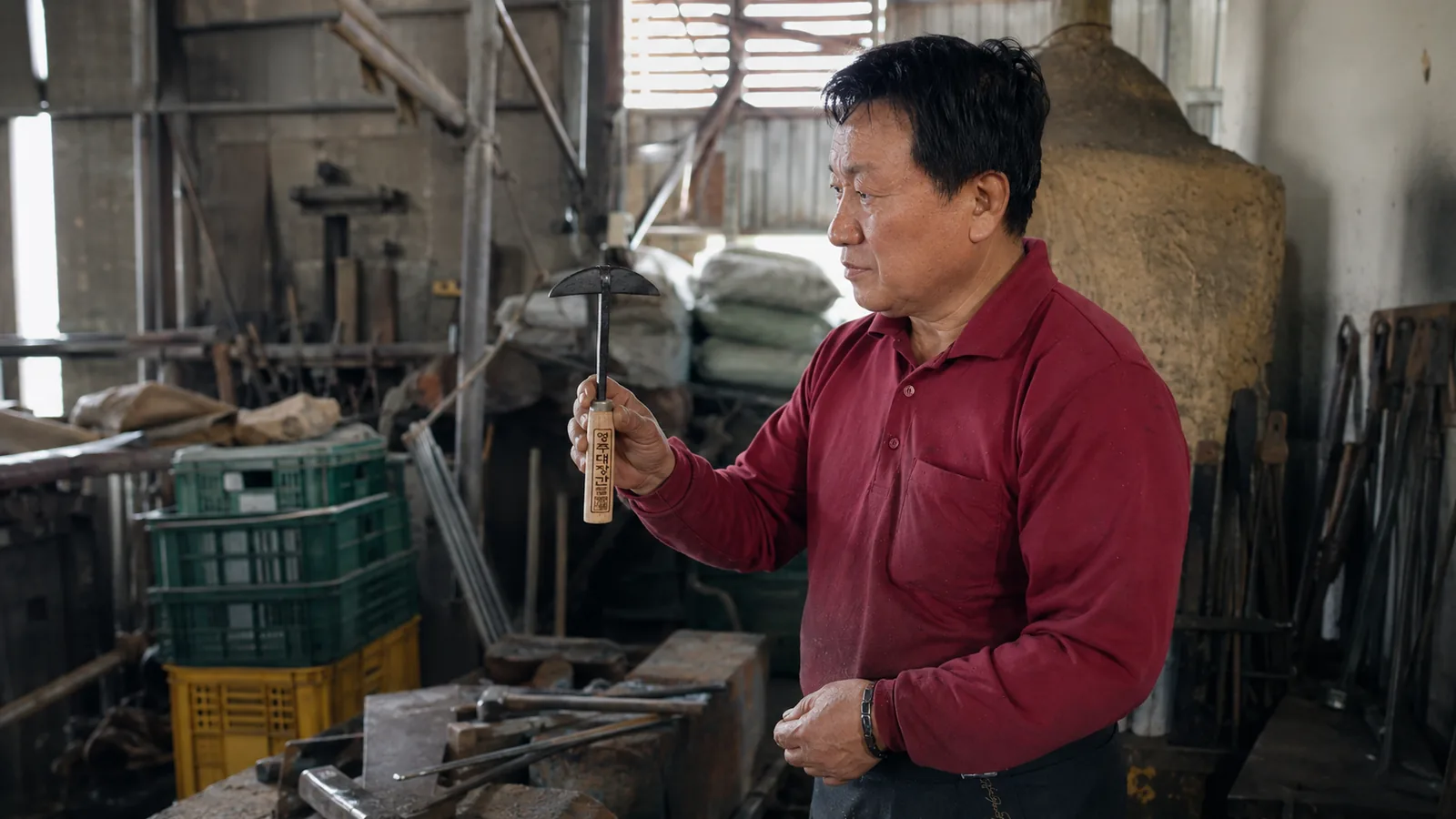
Seok Nok-gi does not begin by checking a digital temperature display. He watches the color of the steel.
If it is not hot enough, it is difficult to shape. If it is overheated, the material can be damaged. Once it comes out of the fire, there is little time to decide where to leave thickness, where to thin the metal and how far to bend it before it cools.
He has been making those decisions for more than six decades.
But Seok’s story is not interesting simply because he has done the same work for a long time.
Korea changed. Farming changed. Consumers changed.
What makes his story worth following is how he continued to decide what should remain and what should change.
Those decisions can still be found in one of the smallest tools he makes.
The homi.
He Entered a Forge at 14
Seok began learning blacksmithing at around 14.
After finishing elementary school and not continuing to middle school, he started helping his brother-in-law, who operated a blacksmith shop.
At the time, blacksmith shops were still part of everyday rural life in Korea. Farmers depended on sickles, hoes and other hand tools, and local blacksmiths made and repaired much of that equipment.
What began as helping at the forge gradually became Seok’s trade.
By 23, he had opened his own workshop.
That also changed his relationship with the tools he made.
He was no longer only producing them. He was selling them himself and hearing directly from the farmers who used them.
That relationship would later become one of the most important parts of how the Youngju homi was refined.
He Chose Quality Over Price Competition
As South Korea industrialized and agriculture became increasingly mechanized, the role of rural blacksmith shops declined.
Then cheap imported farm tools added another kind of pressure.
Seok remembers prices being pushed lower and lower. If one seller offered something for 100 won, another might sell it for 80, then 70.
He faced the same choice as other makers.
Use cheaper material.
Make more pieces in less time.
Compete on price.
Or take a different route.
Seok chose the latter.
By the late 1980s, he had decided that a small traditional forge could not win a race to the lowest price. His alternative was to make a product good enough to give buyers a reason to pay more.
That choice also shaped how he dealt with customers.
When one of his products had a problem, Seok says he repaired or replaced it even when the round-trip shipping cost was greater than the price of the tool itself.
His principle was simple:
❝
I take responsibility for what I make.
❞
— Blacksmith, Seok No-gi
His view of price followed the same logic.
If one of his homi cost as much as three cheaper ones, then he believed that one tool had to be judged better than the three.
The point was not that handmade automatically deserved a premium.
The product itself had to justify the difference.
Then Korea Needed His Hands for Sungnyemun Gate
In February 2008, Sungnyemun Gate was devastated by fire.
Restoring the national heritage structure required far more than replacing timber and roof tiles.
Traditional wooden architecture also uses many kinds of iron hardware to connect, reinforce and operate structural elements. A historically grounded restoration could not simply rely on modern standardized hardware.
Traditional forms and production methods had to be understood and reproduced.
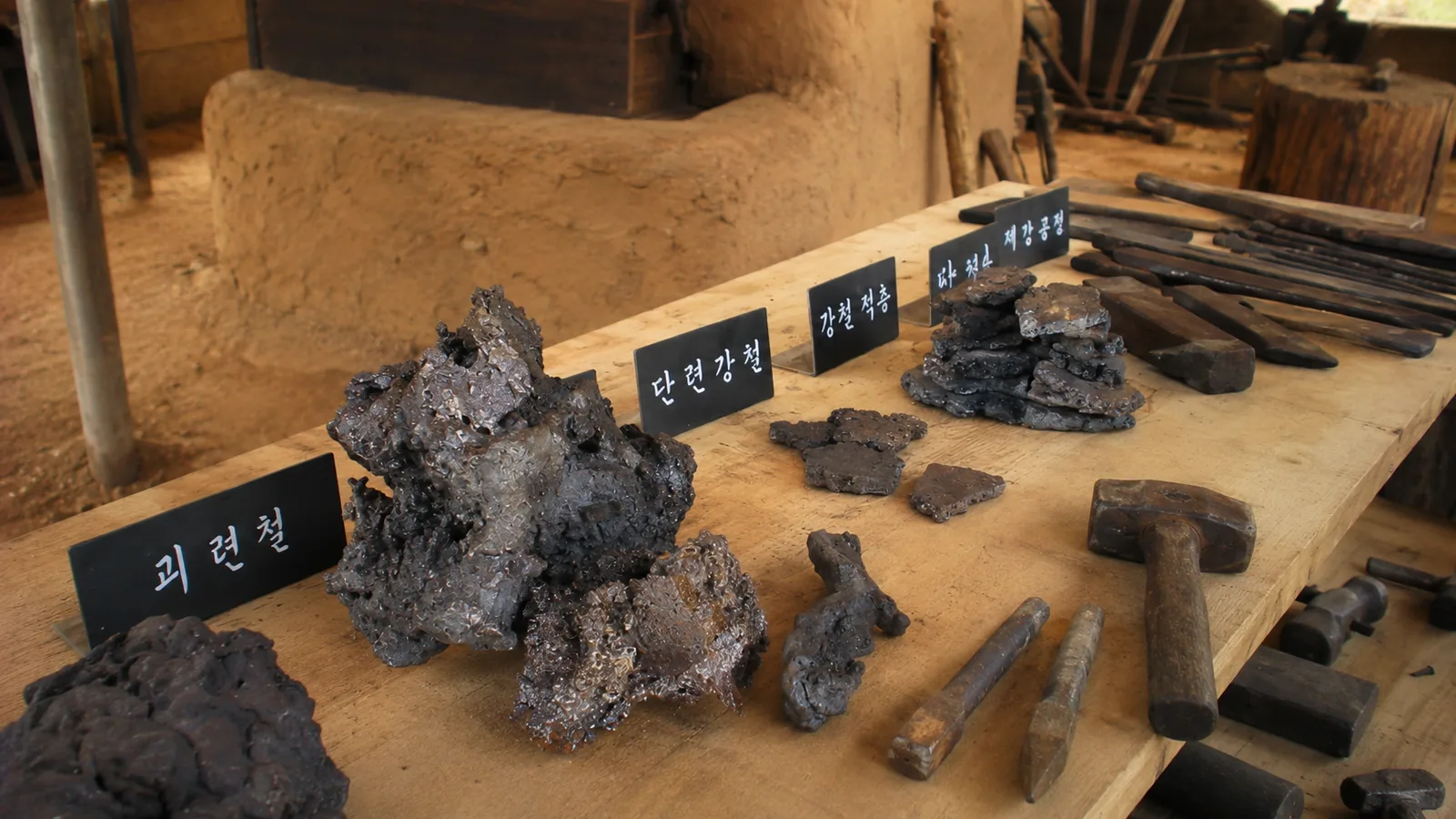
A working forge was established at the restoration site.
It was called the Sungnyemun Daejanggan — the Sungnyemun Gate Blacksmith Shop.

The Cultural Heritage Administration later documented the project in the publication Sungnyemun Daejanggan.
The book records the traditional forge, blacksmithing tools, iron-production methods and processes used to produce traditional architectural ironwork.
In its participant credits, Seok is listed as:
Seok No-gi — Blacksmith, Sungnyemun Gate Ironwork Production
Among the participants listed there, Seok is the only person identified under the role of blacksmith.
This refers specifically to the participant credits in that publication, rather than to every blacksmith involved in the broader restoration project.
This matters for more than prestige. It provides a concrete reference point for the level of blacksmithing skill that had been accumulated over his working life.
Craftsmanship Is Better Seen in Choices Than in Labels
“Craftsmanship” is an easy word to use.
Working for decades does not automatically make a product better.
Neither does being handmade.
What matters more in Seok’s case is the pattern of choices he made.
When price competition intensified, he did not simply move to cheaper materials.
He says he would rather make fewer pieces properly than increase volume at the expense of quality.
He learned to judge heated steel by its color and condition.
When a product failed, he treated it as his responsibility.
And those same accumulated blacksmithing skills were used in the restoration of Sungnyemun Gate.
Seok once compared blacksmithing to painting.
Two painters may use the same brush and paint and still produce different work.
For him, steel and hammers are similar.
The tools may be the same. The judgment is not.

According to project materials and explanations reviewed during K-SELECTIVE’s visit, the restoration work also included examining surviving fire-damaged iron pieces and repairing those that could be reused.
Making a new piece and judging whether an existing one can be preserved are different tasks.
Both require more than following a fixed template.
They require accumulated judgment.
But the Tool He Made Most Was the Homi
Sungnyemun Gate was an exceptional project in Seok’s life.
But most of the iron he has shaped was not made for a national treasure.
It was made for farmers.
For soil.
For weeds.
For one of Korea’s most familiar agricultural hand tools.
The homi.
The hands that produced traditional ironwork for Sungnyemun Gate are the same hands that have spent decades making this everyday tool.
That changes the question.
Instead of asking only whether the homi is handmade, it is more useful to ask:
Where does that accumulated skill appear in the tool itself?
A Good Homi Is Not Simply Thick
One of the first things Seok discussed when explaining a good homi was thickness.
Not how thick the entire tool is.
Where it is thick.
Different parts of the homi do different jobs.
The neck and other areas that receive more force need strength.
The working edge that enters the soil and cuts through weeds needs to remain relatively thin.
So the useful distinction is not simply thick versus thin.
It is:
where thickness is needed, and where it is not.
The goal is to keep strength where force is concentrated without making the entire tool unnecessarily heavy.

The Curve Has a Purpose
The blade and handle of a homi do not form a straight line.
To someone unfamiliar with the tool, that bend can look like a traditional shape that simply survived over time.
Seok explains it through use.
As a child, he watched ox-drawn plows and noticed that the angle affected how deeply the plow entered the soil and how much force was required.
That experience later influenced how he thought about the homi.
If the angle is too open, the tool can dig too deeply and require more effort.
If it is too closed, it may require less force but fail to work the soil as effectively.
The useful angle is therefore a balance between:
how deeply the blade enters, how much force the user applies, and how that force is transferred when the tool is pulled.
He Chose Steel That Was Harder to Work
When price competition intensified, some inexpensive farm tools were made from materials that were easier and cheaper to shape.
Seok recalls seeing rebar-type or softer steel used for agricultural tools.
His concern was what happened during use.
If the material was too soft, the blade could bend or curl.
He chose automotive leaf-spring steel instead.
It was harder to cut.
Harder to stretch.
Harder to forge.
But he continued using it even if the finished product had to cost more.
He once marked his tools with the name “Youngju Spring” to distinguish that material choice.
The material also connects directly to the earlier discussion of thickness.
A stronger material gives the maker more freedom to keep strength where it is needed without simply making the entire tool heavier.
Material, thickness and weight are therefore connected.
This Is Where Human Judgment Matters
Machines are good at repeating a predetermined form quickly and consistently.
Seok describes value in a different part of the process.
Looking at the material and deciding what it needs.
When heating steel, he does not rely only on a numerical temperature reading.
He judges it by the type of steel, its color and its condition.
Too much heat can damage the material.
Once the steel comes out of the fire, thickness, angle and shape have to be adjusted before it cools.
This is why “handmade” is not the most important word here.
The value is not simply that a human hand touched the object.
It is that the process leaves room for experienced judgment while the object is being formed.

The Blacksmith Did Not Shape the Homi Alone
Seok did not rely only on his own judgment.
Because he sold the tools himself, farmers continually told him what worked and what did not.
Their requests were not always the same.
One said the angle was too open.
Another wanted it more closed.
One thought the tool was too heavy.
Another said a tool that was too light bounced during use.
Following one person’s preference would not necessarily work for everyone.
So Seok says he listened to many users and looked for problems and preferences that kept appearing repeatedly.
Those recurring points became new production criteria.
The blacksmith made it. Farmers helped refine it.
That is one of the clearest ways to understand how the Youngju homi reached its present form.
Tradition Did Not Mean Leaving the Product Untouched
This is also where Seok’s approach to tradition becomes clearer.
At Sungnyemun Gate, the purpose was to recover traditional forms and production knowledge as faithfully as possible.
A working agricultural tool has a different responsibility.
It has to remain useful to the people who use it.
If farmers found the weight uncomfortable, it could change.
If the angle was wrong, it could change.
Materials could change.
And when the homi began traveling overseas, the process changed again.
According to Youngju Daejanggan, both domestic and export homi now follow the same nine-stage production process.
The anti-corrosion step was introduced after overseas distribution exposed the tools to longer transport and greater vulnerability to moisture. What began as a response to overseas conditions eventually became part of the standard process for all products.
The important point is not simply that another production step was added.
It is the pattern:
use → feedback → problem identified → adjustment.
The tradition remained. The product did not stand still.
For Seok, preserving a craft has not meant refusing change.
It has meant keeping what should not change while continuing to change what should.

Then the World Discovered the Homi
Seok did not begin making homi with the global gardening market in mind.
He was already selling products online when he began hearing that some of his tools were reaching the United States.
At first, he assumed they were probably being bought by Koreans living abroad who remembered using them back home.
In some cases, international shipping cost several times more than the tool itself.
Then the homi began appearing on Amazon.
Seok says that at first he did not even know what Amazon was.
But as overseas gardeners began using the tool, the context changed.
A tool so familiar in Korea that few people stopped to explain it suddenly looked distinctive abroad.
Its curved blade.
Its pulling motion.
Its ability to dig, scrape and weed.
The Korean homi found a new audience.
And as demand grew, similar lower-priced products also appeared.
Youngju Daejanggan says it became increasingly aware of copied forms and began using identifying details such as shape and markings to distinguish its own products.
What Did the World Actually Discover?
This was the question K-SELECTIVE originally went to Yeongju to investigate.
Why did overseas consumers find an ordinary Korean farm tool so interesting?
Part of the answer may be cultural novelty.
Part of it may be the unfamiliar shape.
But the visit revealed something more specific.
Seok could explain why one part of the tool needed to be thicker.
Why the working edge needed to remain thin.
Why the angle mattered.
Why he chose a more difficult steel.
And those decisions did not come from one maker’s intuition alone.
They had been shaped through decades of use and feedback from farmers.
When the tool moved overseas, new environments added new feedback again.
What global consumers encountered was not simply an old Korean form.
They encountered a tool that had already been repeatedly adjusted through use.
Seok No-gi Did Not Just Preserve a Tradition. He Kept It Alive.
Industrialization and agricultural mechanization reduced the everyday need for traditional rural blacksmith shops.
Cheap imported tools made hand production even harder to sustain economically.
Seok lived through those changes.
His answer was not to become faster than a machine.
It was not to become cheaper than a factory.
He kept the accumulated skills and judgment of blacksmithing while continuing to listen to the people using the products.
First, they were farmers in Korea.
Then domestic consumers.
Later, overseas sellers and users.
He kept what should not change, and kept changing what should.
That may be the clearest way to understand why Youngju Daejanggan has continued to survive.
So Is This Homi Worth Paying More For?
At this point, the story of the craftsman has to return to the consumer.
A famous maker does not automatically justify a higher price.
Neither does Seok’s participation in the restoration of Sungnyemun Gate automatically prove that his homi performs better than every competing tool.
The product still has to be judged as a product.
The useful questions are:
What creates the difference in price?
And:
Will that difference matter in the way you actually use the tool?
For someone who regularly works in a garden or vegetable plot, blade thickness, angle, weight, material, accumulated production experience, user feedback and after-sales responsibility may all matter.
For someone caring for only a few small pots, a simpler and cheaper gardening tool may be entirely sufficient.
Not everyone needs an artisan-made homi.
But products do not become identical simply because they share the same basic shape.
K-SELECTIVE VIEWPOINTS
1. “Handmade” matters less than being able to explain why it is made that way.
Handwork alone does not make a better tool.
What matters in the Youngju homi is that major production decisions are connected to practical reasons: where strength is needed, where weight should be reduced, how the angle affects use and why a particular material was chosen.
The better question is not:
Was it made by hand?
It is:
What does making it this way actually change?
2. Sungnyemun Gate is evidence of the skill’s context, not proof of the product.
Seok’s role in producing traditional ironwork for Sungnyemun Gate does not prove that his homi is automatically superior.
What it does show is that his blacksmithing knowledge was not merely decorative heritage or demonstration craft.
It was used in an actual national heritage restoration project.
That provides meaningful context for the level of accumulated skill behind the everyday tools he continues to make.
3. The most interesting tradition here may be the way the product keeps changing.
Seok did not preserve the homi by refusing to alter it.
Farmers influenced its weight and angle.
Overseas transport introduced another problem.
The production process changed again.
At Youngju Daejanggan, tradition is not simply a fixed form.
It is closer to a set of skills and standards kept useful through continuous adjustment.
K-SELECTIVE VERDICT
SELECTED — Worth Considering If You Will Actually Use It
K-SELECTIVE originally went to Yeongju because of the homi.
We wanted to understand why such an ordinary Korean farm tool had become interesting to global consumers, and whether there was a meaningful reason to choose a Youngju homi over the many similar-looking alternatives now available.
But the story began long before Amazon.
A 14-year-old boy entered a forge.
He later watched rural blacksmith shops disappear.
When imported tools pushed prices downward, he chose not to compete by making his products cheaper.
His accumulated blacksmithing skills were eventually used to produce traditional ironwork for the restoration of Sungnyemun Gate.
Then he returned to Yeongju and continued making the agricultural tool he had spent most of his life producing.
But the homi itself did not remain fixed.
Farmers complained.
He adjusted it.
The tool moved overseas.
New problems appeared.
He adjusted it again.
That is why the Youngju homi is difficult to explain simply as:
a traditional Korean farm tool,
a handmade craft object,
or
a Korean Homi that became popular overseas.
A more accurate description is:
A working tool built on old skills and repeatedly refined through use.
Perhaps what Seok No-gi has preserved all these years is not the old shape of the homi.
It is a standard for making a good tool.
And that is why the same hands once used to produce ironwork for the restoration of Sungnyemun Gate are still making an everyday homi in Yeongju today.

Product Information
PRODUCT
Youngju Daejanggan Homi
maker
Youngju Daejanggan
Craftsman
Seok Nok-gi
origin
Yeongju, Gyeongsangbuk-do, South Korea
category
Gardening & Agricultural Hand Tool
material
Automotive leaf-spring steel, according to the maker
production
Forged steel with hand-adjusted shaping
primary use
Weeding, digging, scraping, pulling soil and small-scale garden work
Review method and limitations
K-SELECTIVE visited Youngju Daejanggan in Yeongju, Gyeongsangbuk-do, in August 2026 and interviewed blacksmith Seok No-gi in person.
During the visit, we discussed his production methods, material choices, blade thickness, tool angles, consumer feedback, pricing philosophy, after-sales responsibility, online sales and overseas distribution. K-SELECTIVE also purchased a Youngju Daejanggan homi on site.
For the Sungnyemun Gate section, K-SELECTIVE reviewed historical photographs and materials kept by Seok’s family, as well as the Cultural Heritage Administration publication Sungnyemun Daejanggan.
In the publication’s participant credits, Seok No-gi is listed as:
“Blacksmith — Sungnyemun Gate Ironwork Production.”
Within that participant list, he is the only person identified under the role of blacksmith.
This article does not independently test the precise alloy composition or mechanical properties of the leaf-spring steel used by Youngju Daejanggan.
K-SELECTIVE also did not conduct a long-term controlled comparison between the Youngju homi and major low-cost or mass-produced competing products currently sold in Korea or overseas.
We therefore do not treat Seok’s participation in the Sungnyemun Gate restoration, his years of experience or his production philosophy as proof of absolute product superiority.
The current nine-stage production process described in this article is based on Youngju Daejanggan’s explanation and now applies to both domestic and export products. K-SELECTIVE did not independently verify every individual production stage.
SOURCES
- K-SELECTIVE Field Interview — Seok No-gi, Youngju Daejanggan, Yeongju, August 2026
In-person interview covering Seok’s blacksmithing career, material choices, homi design, farmer feedback, pricing philosophy, after-sales responsibility, and overseas distribution. - OliveCultural Heritage Administration — Sungnyemun Daejanggan
Official publication documenting the Sungnyemun Gate restoration blacksmith shop, traditional ironworking methods and project participants. Seok No-gi is listed as “Blacksmith — Sungnyemun Gate Ironwork Production.” Young Korea — Medicube AGE-R Booster Pro X2 - Youngju Daejanggan / Seok No-gi Family Archive
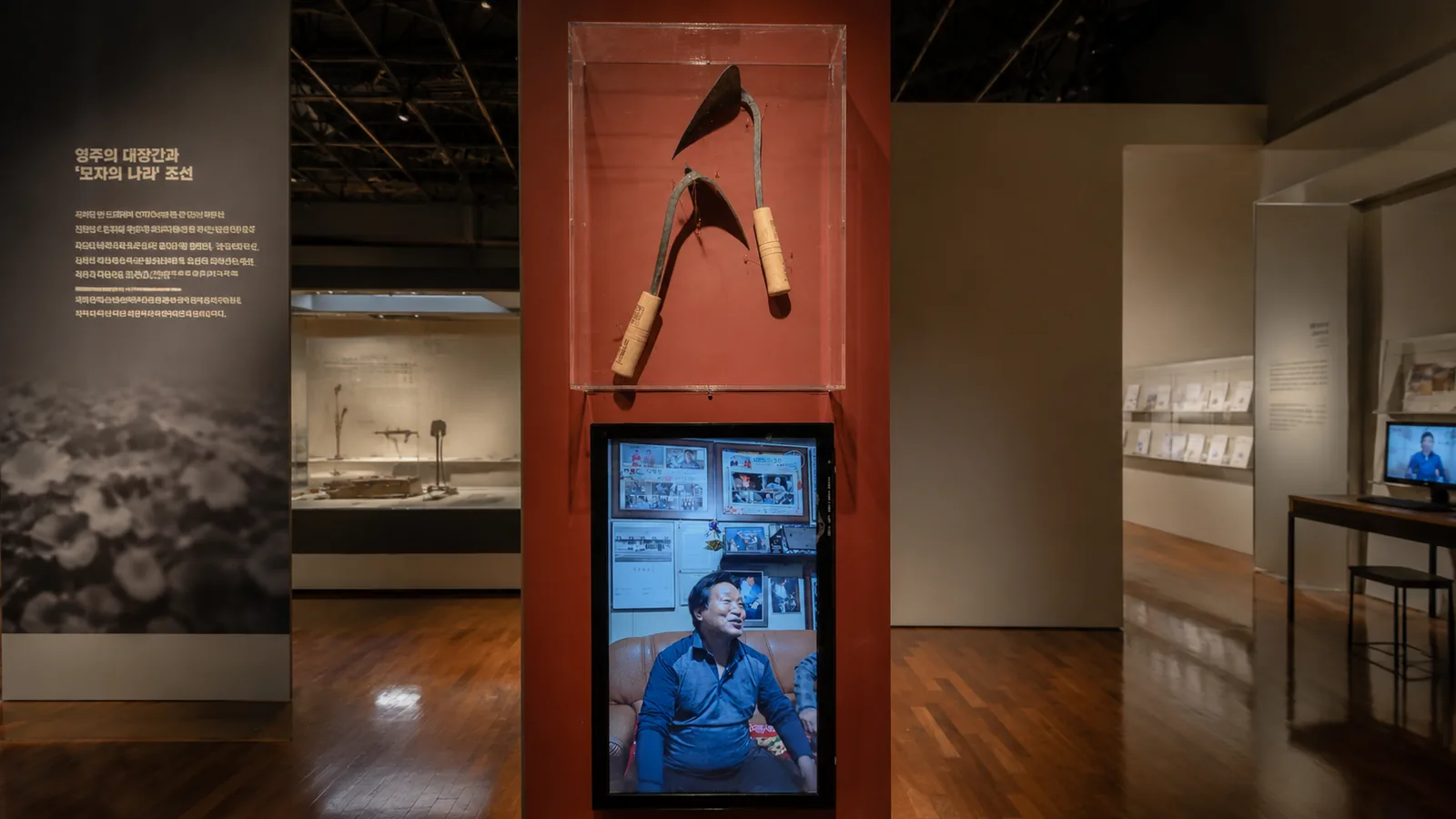
Historical photographs and materials from the Sungnyemun Gate restoration project, including the 2010 traditional ironwork production agreement and on-site blacksmithing work. - National Folk Museum of Korea — Folklore Is Life Special Exhibition, 2022
The exhibition featured Seok No-gi’s work and interview alongside Korean homi types, presenting the homi as an everyday Korean object that later gained global attention. - Rural Development Administration, Nongsaro — K-Homi / Youngju Homi
Agricultural sources documenting Youngju Daejanggan’s overseas exposure, Amazon sales and the homi’s emergence as a gardening tool for global consumers.
RELATED
- When Did “K” Become a Brand?
Why one letter now carries expectations across Korean culture, products and everyday life. - South Korea in 52 Minutes
A documentary becomes a starting point for looking beyond Korea’s familiar global image and into the realities underneath it. - How Hanbok Turned Jongno Back into a “Fashion District”
Another example of Korean tradition surviving not by remaining fixed, but by changing how people actually use it today.
Leave a Reply