
A lunchtime refuge, a traveler’s walking route, and an egret’s hunting ground in central Seoul
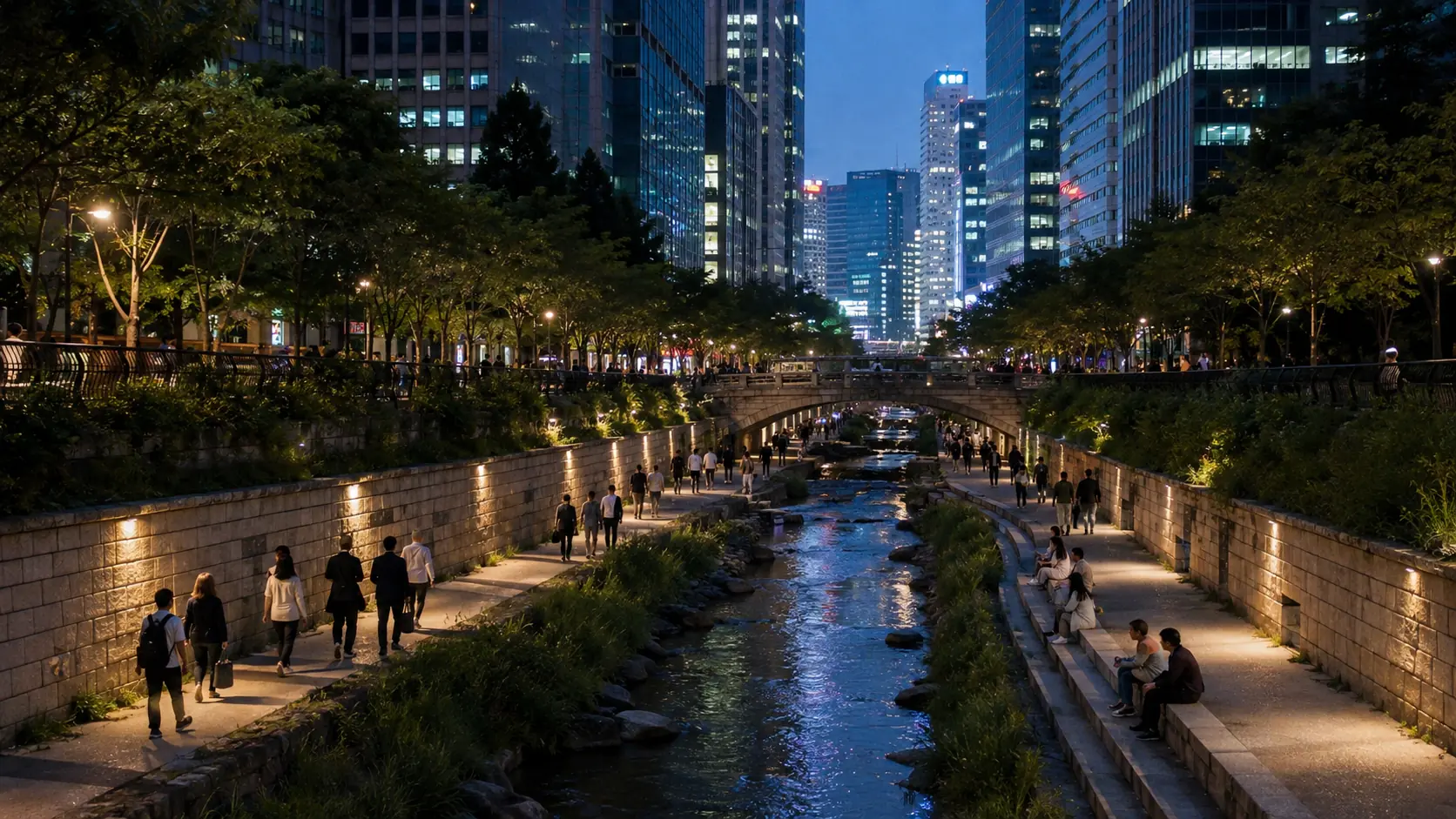
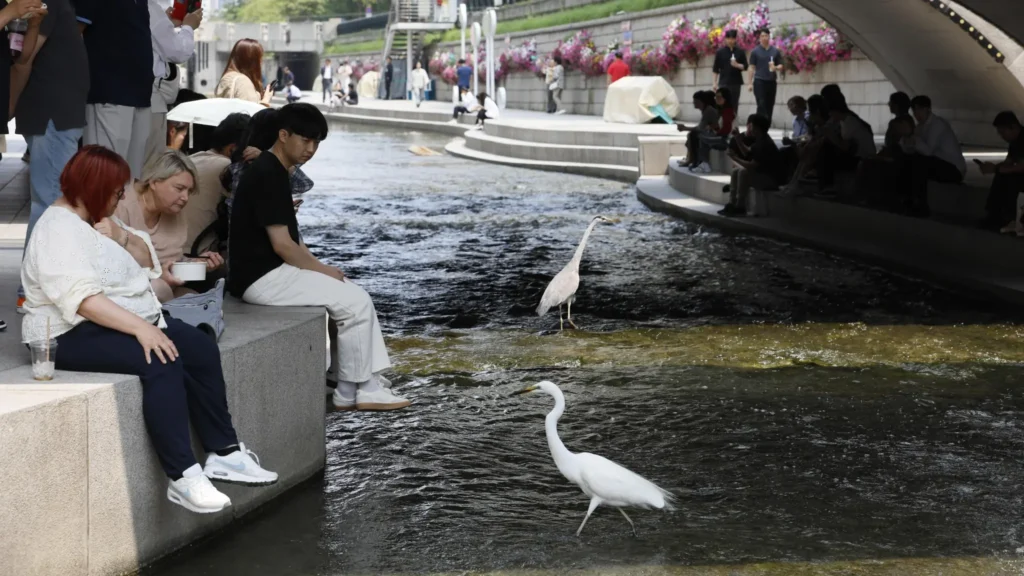
It is lunchtime at Cheonggyecheon. One by one, people walking beside the water begin to stop. At the end of their gaze is an egret waiting for a fish. An office worker reaches for a phone. A traveler slows down. Just a few meters above, traffic continues between rows of office towers.
People and fish, an egret and high-rises—all held in a single frame. Few scenes capture present-day Cheonggyecheon better.
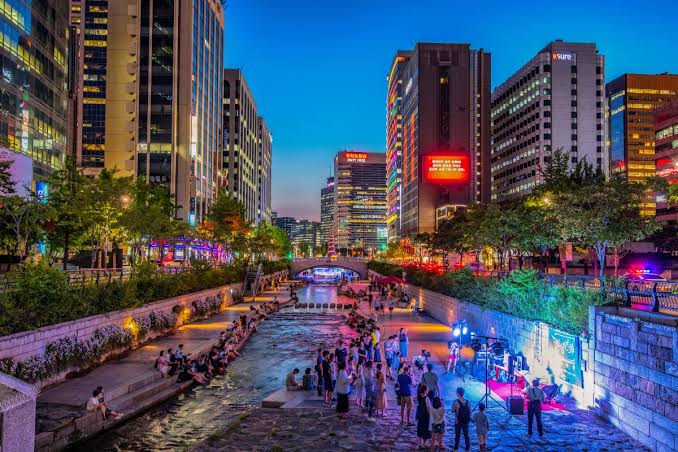
This was once a stream hidden beneath roads and an elevated highway. Today, people gather beside the water again. Fish move through the shallows, and birds arrive to hunt. In spring and autumn, people come to walk. During designated summer programs, they may cool their feet in the water. On winter evenings, seasonal lights draw crowds back after dark.
Cheonggyecheon is not a place to escape Seoul. It is where you meet a different pace of the same city, right at its center.
AT A GLANCE

WHAT IT IS
A way to walk through central Seoul at a different pace
Cheonggyecheon connects Gwanghwamun, Jongno, and the Euljiro area on foot, placing well-known sights and ordinary city life along the same route. A 30-minute walk works. If the stream draws you in, stay for an hour or two.

BEST FOR
Travelers who want to see the Seoul between its landmarks
It suits people who would rather connect Gwanghwamun, Jongno, and Euljiro slowly than move from one famous stop to the next.

WHY IT MATTERS
A waterside path where tourism and everyday life overlap
Office workers, travelers, families, and regular walkers share the same space. When an egret appears, people who do not know one another sometimes stop to look in the same direction.
PEOPLE COME FIRST
An unexpected find for travelers, a familiar refuge for Seoulites
The first thing you notice at Cheonggyecheon is the water. Stay a little longer, and you begin to notice the people using it.
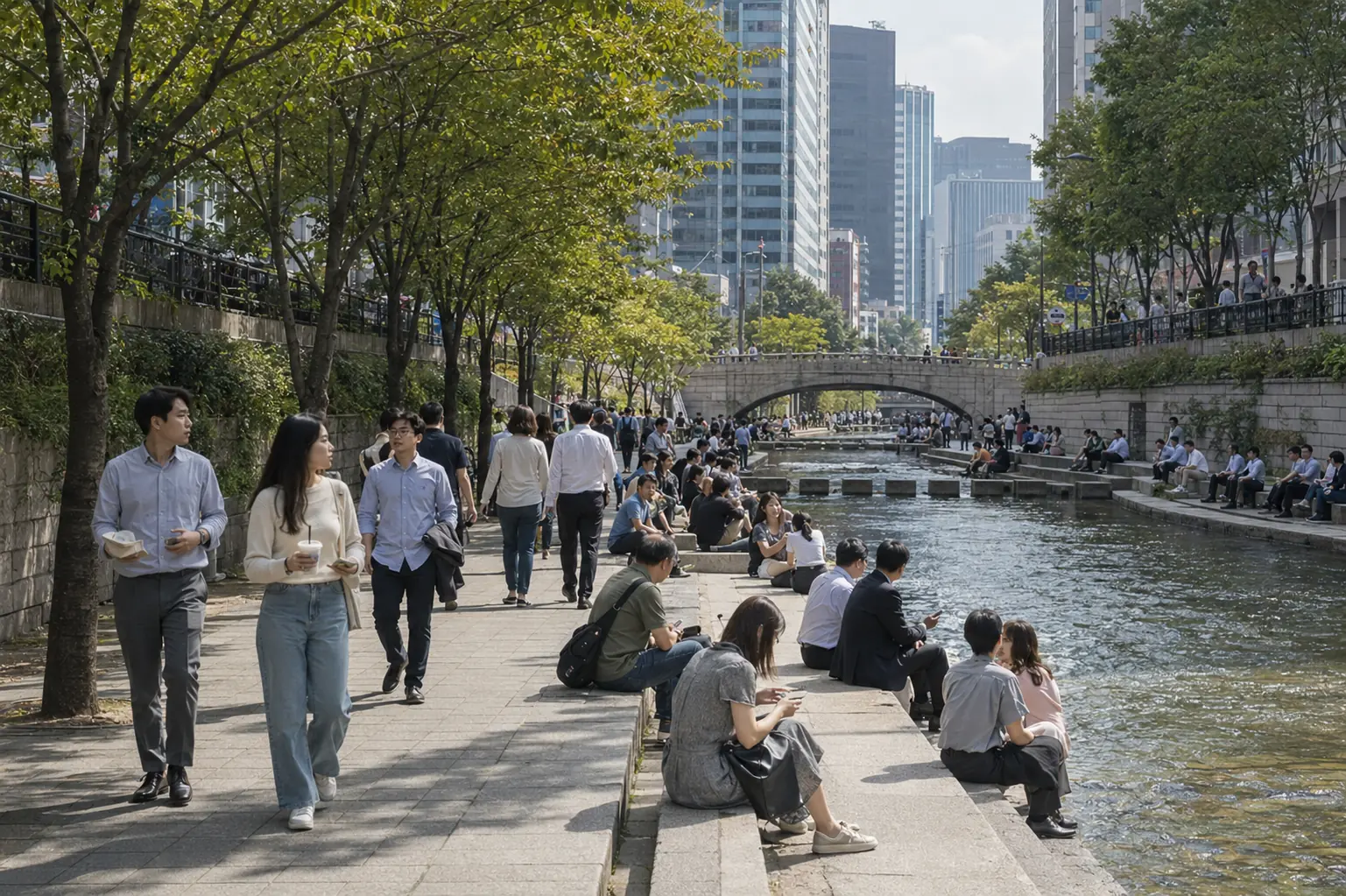
At lunchtime, office workers come down carrying coffee or a quick meal. Travelers cross the stepping stones or pause before continuing to their next stop. During designated summer events, families gather near the water with children. For one person, it is an accidental discovery on a trip through Seoul. For another, it is the closest place to take a break from the working day.
Interviews released around a summer program captured that contrast. One university student pointed out that reaching a valley outside Seoul could take hours and often required a car, while Cheonggyecheon was accessible by bus. International visitors spoke of the surprise of finding water, greenery, and everyday city life together in the middle of Seoul.
You do not have to travel far to reach it, and people arrive for entirely different reasons. That simple mix is why Cheonggyecheon feels like a visitor attraction without ever becoming only one.
BEFORE THIS STREAM
This view was not always here
Cheonggyecheon had long been a waterway running through Seoul. During the city’s rapid postwar growth, the stream was covered by roads, and an elevated highway was built above the corridor.
As the structure aged, Seoul chose removal and restoration rather than building the same road again. The restoration project ran from July 2003 to September 2005, and the renewed stream opened to the public on October 1, 2005. A space once dominated by vehicles became a waterside route where people could walk again.
Today’s Cheonggyecheon is not the untouched return of an old natural stream. It is a constructed and managed urban waterway shaped around the conditions of central Seoul. Even so, the visible change is difficult to miss. People descended into space once occupied by road infrastructure, while fish and urban birds became part of the cityscape.
The water was not the only thing that returned. Footsteps—and people’s attention—returned with it.

NATURE IN THE MIDDLE OF SEOUL
When an egret makes the city stop
Egrets and herons can sometimes be seen waiting for fish in Cheonggyecheon. What makes the encounter interesting is not only the bird, but the reaction of the people who notice it.
When a bird settles into the shallows, walkers stop and phones begin to rise. Office workers and travelers briefly look toward the same point. If a bird suddenly moves after a fish, a small ripple of surprise may pass through the people nearby.
Here, urban nature is not just part of the background. It becomes an event that changes the way people move.
Traffic continues a few meters overhead while birds wait for food below. Nature and city life are not neatly separated. They occupy the same frame, and that uneasy coexistence is part of what makes Cheonggyecheon compelling.
RESPECT THE WILDLIFE
A close view is not an invitation to move closer. Keep a respectful distance, do not feed wild birds, and avoid blocking their movement.
CHEONGGYECHEON THROUGH THE SEASONS
The stream stays familiar; the reasons to linger change
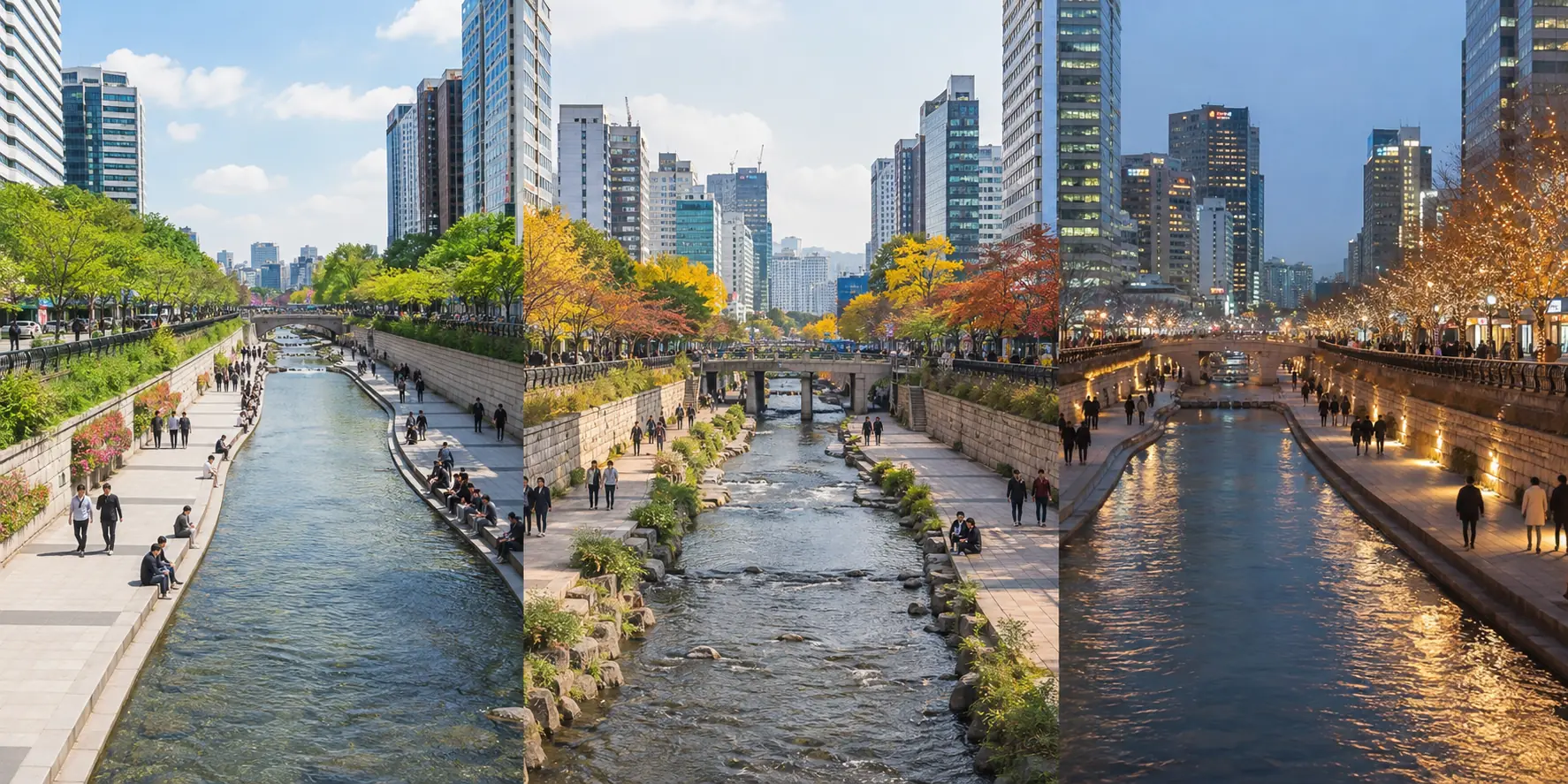
The waterway itself does not transform dramatically from one season to the next. The people who come—and the way they use it—do.
In spring, the paths begin to fill again after the quieter winter months. Cheonggyecheon is not one of Seoul’s classic cherry-blossom destinations. Its appeal is simpler: fresh green along the water and an easy walk from Gwanghwamun toward Jongno and Euljiro. Spring here is less about chasing a particular flower than enjoying a Seoul that feels walkable again.
Summer makes the value of nearby water more obvious. Seoul sometimes operates limited-time programs in designated sections where families and travelers can cool their feet without leaving the city. The entire stream is not a permanent water-play area, however. Dates and operating zones must be checked in advance, and long walks are best avoided during the hottest part of the day.
Autumn is the easiest season for walking without a fixed destination. Rather than taking one photograph at Cheonggye Plaza and turning back, continue toward Euljiro or Dongdaemun. The visitor crowds gradually thin, and commuters and local walkers come into view. There is no need to reach the end. If a side street makes you curious, take the next stairs up.
On winter evenings, a route people usually pass through can become a destination in itself. Seasonal lights reflect on the water, and events around Gwanghwamun and Seoul Plaza draw more people into the area after dark. The trade-off is heavier foot traffic. Event names, dates, and installation zones change from year to year, so check the latest information shortly before visiting.
SEASONAL NOTES
- Most comfortable for walking: Spring and autumn
- Cooling off in the city: Only during designated summer programs and within their operating zones
- Best-known night atmosphere: The year-end winter period
- When to be cautious: Heat waves, monsoon rain, localized downpours, or any on-site access restriction
CHECK BEFORE YOU GO
Summer water programs and winter events change by year. Heavy rain can also cause rapid water-level changes and temporary closures. Check the current official notice and conditions on the day of your visit.
FROM THE STREAM TO EULJIRO
Climb the stairs, and another Seoul begins
Take an exit toward Euljiro and the setting changes within seconds. The sound of water gives way to old tool shops and printing businesses. Between weathered buildings, newer bars and cafés have taken their place.
The area is often nicknamed “Hipjiro,” a blend of “hip” and “Euljiro.” But seeing it only as a neighborhood of fashionable venues means seeing half the story. New businesses and new visitors have entered streets still marked by older industries and commerce, placing different periods of Seoul in the same alley.
Cheonggyecheon and Euljiro do not share the same history. Walk them together, however, and a connection appears.
Cheonggyecheon found a new urban use for an old waterway. Euljiro continues to find new uses inside its older streets.
If you want to see a Seoul that cannot be explained only through what is new, the two belong on the same walk.
A GOOD WAY TO WALK IT
Use the stream to connect Seoul, not as a single isolated stop
You do not need to reserve half a day for Cheonggyecheon alone. Its advantages become clearer when the walk connects naturally with the rest of your plans.
After visiting Gyeongbokgung or Gwanghwamun, enter near Cheonggye Plaza and continue toward Jongno and Euljiro. Thirty minutes is enough for a short look. Allow one or two hours if you plan to sit by the water or explore the surrounding streets.
Gwanghwamun Square → Cheonggye Plaza → Cheonggyecheon walk → Jongno- or Euljiro-side exit
There is no reward for forcing yourself to walk the entire stream. Take the exit closest to your next stop, or change direction when a side street catches your attention. The point is not to complete a prescribed route. It is to connect different versions of Seoul at your own pace.
Access conditions vary by entry point. Depending on the location, you may encounter stairs, ramps, or an elevator. If stairs are difficult, check current official accessibility information and choose suitable entry and exit points before setting out.
✓
WHAT TO EXPECT
- A working city around the water : Traffic, office towers, delivery workers, commuters, and travelers remain part of the view. The stream does not hide the city; it lets you observe city life from a few meters below street level.
- A flexible walk rather than one fixed course : Frequent bridges and exits make it easy to walk one section and return to street level. You can stay for 30 minutes, continue toward Dongdaemun, or leave the water when a Jongno or Euljiro side street catches your attention.
- A changing mix of people and atmosphere : The area near Cheonggye Plaza feels more visitor-oriented, while sections farther east gradually reveal more commuters, local walkers, and the routines of the working city. Lunchtime is lively on weekdays; evenings feel slower except during seasonal events.
- Weather that can change the plan : The route is exposed to Seoul’s heat, cold, and rain. On wet days, the stream can rise quickly and access may close. In summer, use only officially designated water-access zones during their announced operating periods; ordinary swimming and bathing are restricted.
×
WHAT NOT TO EXPECT
- A vast natural park : The buildings remain visible, and traffic can still be heard. If nature itself is the main purpose of your day, the Han River, Seoul Forest, or one of Seoul’s mountains may suit you better.
- A perfectly photogenic scene at every turn : Many sections are ordinary. Cheonggyecheon is less a fully staged attraction than a path through which Seoul’s working day continues to move.
- A perfectly photogenic scene at every turn
- Water play throughout the stream all summer : Water-access programs operate only during announced periods and in designated sections. Check the latest official information before visiting.Water-access programs operate only during announced periods and in designated sections. Check the latest official information before visiting.
WHO IT SUITS
For Travelers Who Prefer Walking Between Landmarksravelers who want to connect Gwanghwamun, Jongno, and Euljiro on foot
Cheonggyecheon is best suited to travelers who want to connect central Seoul slowly and notice the ordinary city life between major sights.
- Travelers who want to walk from Gwanghwamun toward Jongno and Euljiro
- People who enjoy discovering a city on foot more than collecting landmarks
- Second- or third-time visitors looking for a more everyday side of Seoul
- Travelers with 30 minutes to two hours between other plans
Review method and limitations
This editorial was developed from official records of the Cheonggyecheon restoration, current facility and safety guidance, seasonal walking conditions, and the relationship between the stream and nearby central Seoul districts. The people-and-wildlife scenes describe patterns observable at Cheonggyecheon; they do not claim that a particular encounter is guaranteed on every visit.
Summer water-access programs and winter events are temporary. Their names, dates, hours, and operating zones may change each year. Rain can also cause rapid changes in water level and temporary access restrictions. Confirm current conditions before visiting.
K-SELECTIVE VERDICT
SELECTED — A DIFFERENT PACE OF SEOUL
There is no need to call Cheonggyecheon the best attraction in Seoul.
Office workers come down after lunch. Travelers pause on the way to somewhere else. During designated summer programs, children cool their feet in the water. Fish pass through the shallows, birds follow them, and people who notice the movement stop together. Climb the stairs, and the complicated streets of Jongno and Euljiro begin again.
Cheonggyecheon’s appeal is not that it takes you out of Seoul. It is that it lets you meet a different pace of Seoul without leaving its center.
Rather than clearing your schedule for the stream alone, place it on the way from Gwanghwamun to Jongno, or from Jongno toward Euljiro.
Walk slowly. If the people ahead of you stop, try stopping with them.
At the end of their gaze, you may find a version of Seoul you never planned to see.
Place Information
PLace
Cheonggyecheon Stream
suggested starting point
Cheonggye Plaza near Gwanghwamun
Nearest subway
Gwanghwamun Station, Line 5, Exit 5; Jonggak Station, Line 1, is another practical approach
Recommend route
Gwanghwamun Square → Cheonggye Plaza → Cheonggyecheon → Jongno- or Euljiro-side exit
Best walking seasons
Spring and autumn; early evening also works well in warmer months
Operating conditions
Fountain, lighting, and event schedules vary by season. Stream access may be restricted during heavy rain or maintenance
Accessibility
Entrances vary: some use stairs, while selected points provide ramps or elevators. Check a suitable entry and exit before visiting
Last checked
August 13, 2026
CURRENT INFORMATION NOTE
Cheonggyecheon is an open-air public waterway, but individual facilities and events follow separate schedules. Rain can raise the water level quickly and trigger temporary access restrictions. Check the official notice and on-site conditions on the day of your visit.
SOURCES
Leave a Reply