
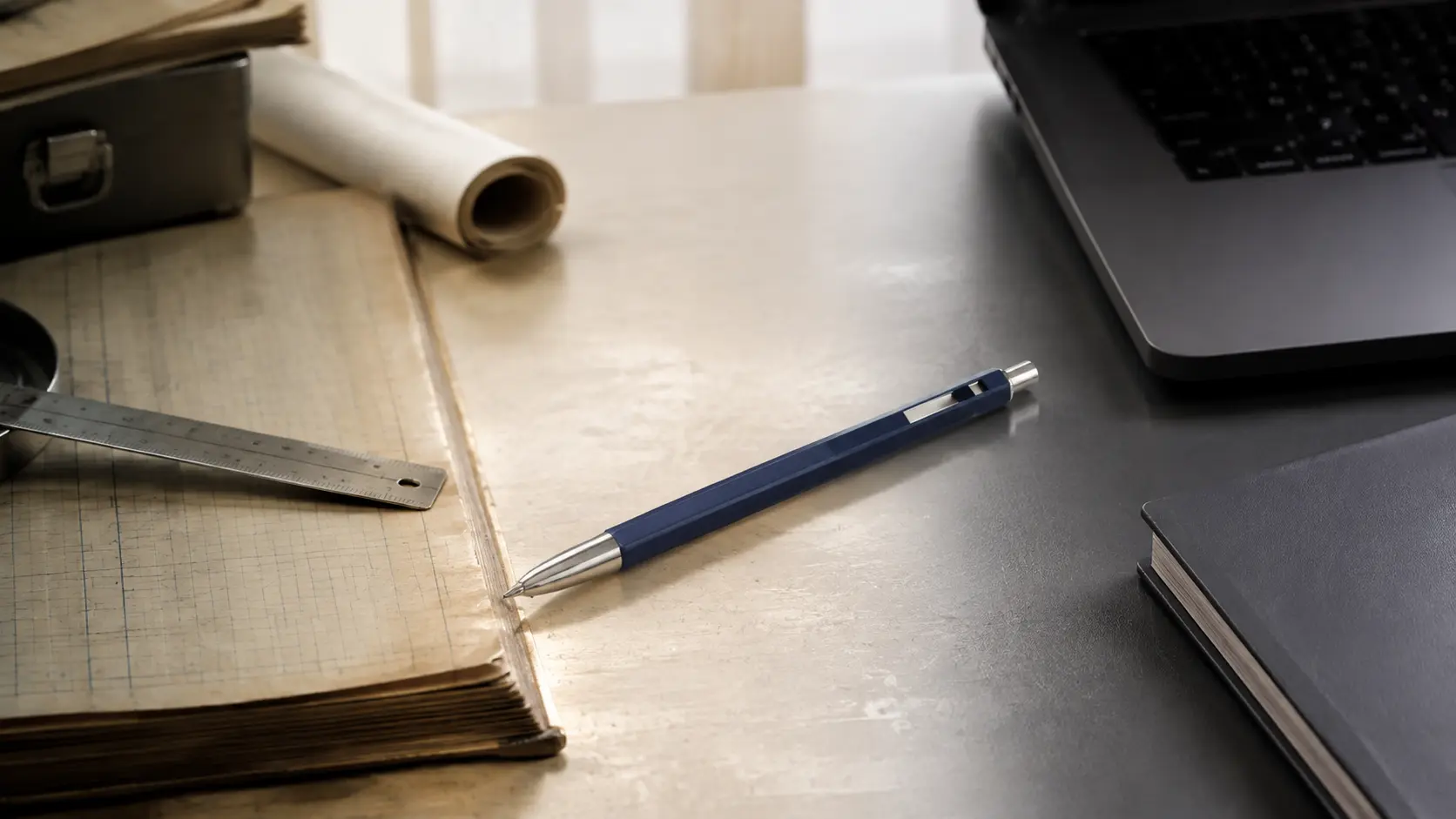
The everyday pen that accompanied Korea through industrialization lives on in metal—still recording the present, and ready for whatever comes next.
Some products become iconic because they are rare. The Monami 153 became iconic for the opposite reason: it was everywhere.
For generations in Korea, the slim white ballpoint pen could be found in classrooms, public offices, factories, shops and homes. It signed forms, marked calculations, recorded orders and filled notebooks. It was inexpensive enough to be ordinary, yet so present in everyday life that it became part of the country’s visual memory.
The Monami 153 ID begins with that memory. It keeps the recognizable hexagonal profile but gives it a matte metal body, added weight and a more deliberate finish. The result is not simply a more expensive version of a familiar pen. It is a way of carrying an everyday Korean object from one era into another.
AT A GLANCE

BEST FOR
People who value Korean design heritage, a moderately weighted metal pen and gifts with a story.

FORMAT
Click-action matte metal ballpoint; supplied in 1.0 mm and compatible with a 0.7 mm refill.

PRICE
Around KRW 15,000–20,000 in Korea, depending on retailer, color and engraving.

POSITION
A premium continuation of Korea’s everyday 153—not a luxury pen detached from its origins.
Mon Ami: A Friend, Not a Monument
The name Monami carries an idea already suited to this object: mon ami, “my friend” in French.
A friend is not valuable because they remain unchanged in the past. A friend remembers where we came from while continuing to share the present. The 153 ID works in much the same way. It holds the memory of the original pen, but its value is completed only when someone uses it to write what comes next.
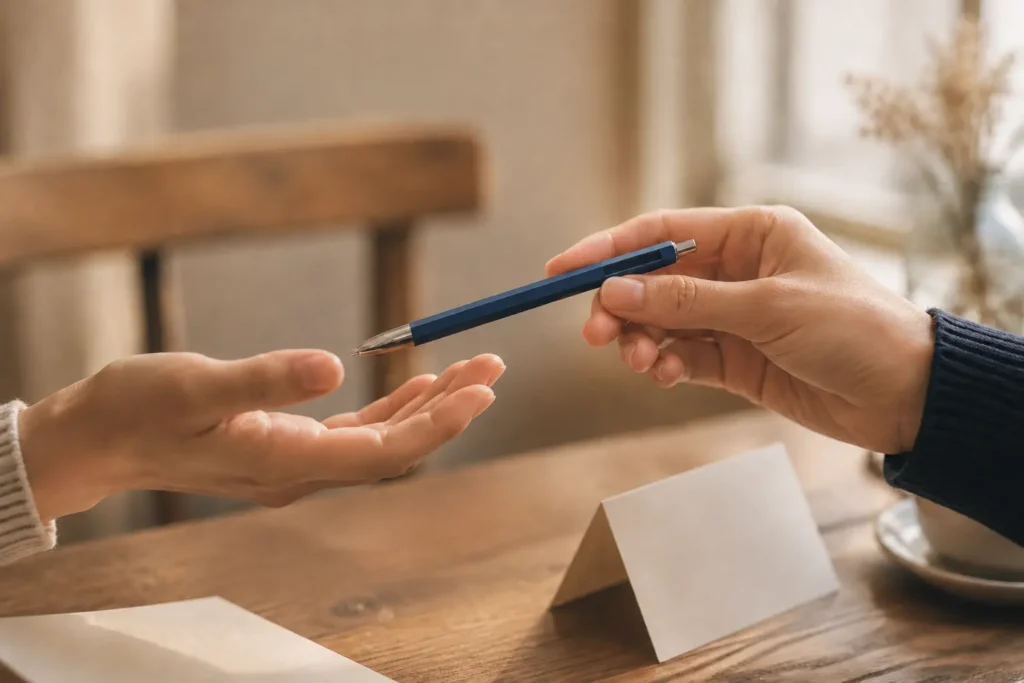
That is also why it makes sense as a gift. Giving the 153 ID is not merely handing over a premium ballpoint. It is sharing a small piece of Korean memory and inviting another person to add their own words to it.
The Pen That Wrote Alongside Industrial Korea
Monami began producing the original 153 in 1963, when Korea was entering a period of rapid industrial growth. Monami describes it as Korea’s first ballpoint pen. Its construction was simple: a hexagonal body, a head, a push mechanism, a spring and an ink refill. The shape helped stop it from rolling off desks and made it easy to hold; the low price put it within reach of almost anyone.
The scale of that familiarity is difficult to overstate. In a 2021 account of the product’s history, Monami said approximately 4.3 billion BP 153 pens had been sold in Korea and abroad.
That simplicity made the 153 more than a stationery success. It became a practical companion to the people building modern Korea. The pen passed through the hands of students preparing for exams, clerks processing documents, engineers checking figures, shopkeepers keeping accounts and workers recording the day’s output. It was a small medium through which countless hours of effort were turned into words, numbers, signatures and plans.
To call it a witness to industrialization is not to romanticize a plastic pen. It is to recognize how history is actually lived: through repeated actions and ordinary tools. The original 153 was present while millions of people studied, worked, planned and built. Their sweat and effort may not remain in museums, but the pen they used is still immediately recognizable.

From Utility to Identity
In 2014, Monami introduced a premium 153 line that included the 153 ID. The timing matters. By then, the original pen no longer needed to prove its usefulness, and digital tools had already absorbed much of the writing once done by hand. The question was no longer whether Korea needed another ballpoint pen. It was whether a familiar design could carry new value.
The 153 ID answered by preserving the outline and changing the experience. The metal body gives the pen a reassuring density. Its balance feels more intentional, and the click has the compact satisfaction of an object made to be kept rather than casually replaced. What was once almost invisible through familiarity becomes visible again.
This is not luxury built by hiding humble origins. The humble origin is precisely the point. The 153 ID works because it does not abandon the ordinary white pen behind it. It lets that history remain legible in a form suited to a desk, a bag or a gift today.
Why This Selection Is Personal
I have bought and used both the original 153 and the 153 ID. I have also given them as gifts. That matters to this selection because the difference between the two is clearest in real life, not in a specification table.
The original 153 is the pen you reach for without thinking. The 153 ID makes you notice the act of reaching. Its weight, cool metal surface and familiar geometry turn an unconscious tool into a chosen object.
I also remember encountering the 153 ID at a second-floor Monami Concept Store in Seogyo-dong around six years ago. In that setting, the pen felt less like a premium novelty and more like a piece of Korean design being reconsidered in public. It was familiar enough to trigger memory, yet finished well enough to imagine giving to someone else.
That has remained the most convincing use case for me. The 153 ID is practical, but it also carries a story that can be shared without a long explanation. For someone who grew up around the original pen, the recognition is immediate. For someone outside Korea, it offers an accessible entry point into the country’s everyday design history.
Review Analysis
Public owner reviews reinforce the distinction between function and meaning. The strongest signals are not that the 153 ID writes in an unprecedented way, but that its weight, balance, familiar form and durability change the relationship people have with a very familiar pen.
◎
REVIEW SCOPE
This analysis combines an early-use review published in 2014, a six-year ownership review published in 2020, recurring qualitative buyer comments and K-SELECTIVE’s firsthand purchase, use and gifting experience. These sources are useful for identifying repeated benefits and points of friction, but they do not form a complete or normalized marketplace dataset.
| PRODUCT ATTRIBUTE | Repeated Positive | Repeated Friction | K-SELECTIVE Read |
|---|---|---|---|
| Metal body and forward-weighted balance | More substantial than the plastic 153; the tip settles steadily onto the page. | The same weight may feel tiring to people who prefer an almost weightless pen. | Stability and physical presence are benefits only when the owner enjoys a weighted pen. |
| Supplied 1.0 mm refill | Smooth ink flow and a bold, even line make everyday writing feel confident. | The line can feel too broad for small handwriting or tightly ruled notebooks. | The compatible 0.7 mm refill is the more suitable choice for finer writing. |
| Familiar hexagonal form in metal | Owners recognize the identity of the original 153 while gaining a more durable object. | Buyers focused only on writing performance may see the redesign as cosmetic. | The continuity of the form is not decoration; it is where much of the product’s cultural value resides. |
| Refillable premium positioning | Long use, engraving and restrained packaging support attachment and gifting. | The price feels high when compared only with inexpensive pens, and refill access should be checked outside Korea. | Its value becomes convincing when durability, design history and the gift experience are judged together. |
“
It is the only ballpoint pen I always carry and feel attached to. It changed how I think about ballpoint pens.
”
Translated from Korean · Six-year owner review · Jantetown, 2020
“
At KRW 15,000, it feels expensive if you judge it only by performance.
”
Translated from Korean · Early-use review · Reinia, 2014
What Buyers Tend to Notice
Public buyer comments reinforce that distinction between function and meaning. The points below are directional signals rather than a statistical review score, but they recur often enough to clarify how the product is experienced.
The positives
- The metal weight feels substantial. Buyers frequently describe the pen as more solid and durable than the original plastic 153.
- The balance supports controlled writing. Some users particularly like the slightly forward-weighted feel, which helps the tip settle onto the page.
- The writing feels smooth and confident. The supplied 1.0 mm refill produces a bold, easy-flowing line, and the option to use a 0.7 mm refill gives owners a finer alternative.
- It works well as a gift. The recognizable design, restrained finish and engraving options offered by some retailers give it more emotional value than a generic office pen.
- It is made to remain in use. A replaceable metal refill changes the relationship from disposable stationery to an object worth keeping.
The trade-offs
- The 1.0 mm line can feel too broad. People who write small or prefer fine Japanese gel pens may want to change to a 0.7 mm refill.
- The weight is part of the appeal, but not for everyone. Those who prefer an almost weightless pen may find it tiring during long sessions.
- Its price cannot be justified by writing performance alone. If the only question is how cheaply a pen can put ink on paper, the original 153 already wins.
- Metal-on-metal sensations may divide users. A few buyers notice minor friction or sound around the moving components more than others do.
These are not defects hidden beneath the story. They define the choice. The 153 ID asks the buyer to value physical presence, continuity and ownership alongside basic performance.
Why Buy a Pen in the Digital Age?
Most records now begin on a screen. We type faster than we write, search instead of remember and send without touching paper. The 153 ID does not compete with that efficiency, nor should it.
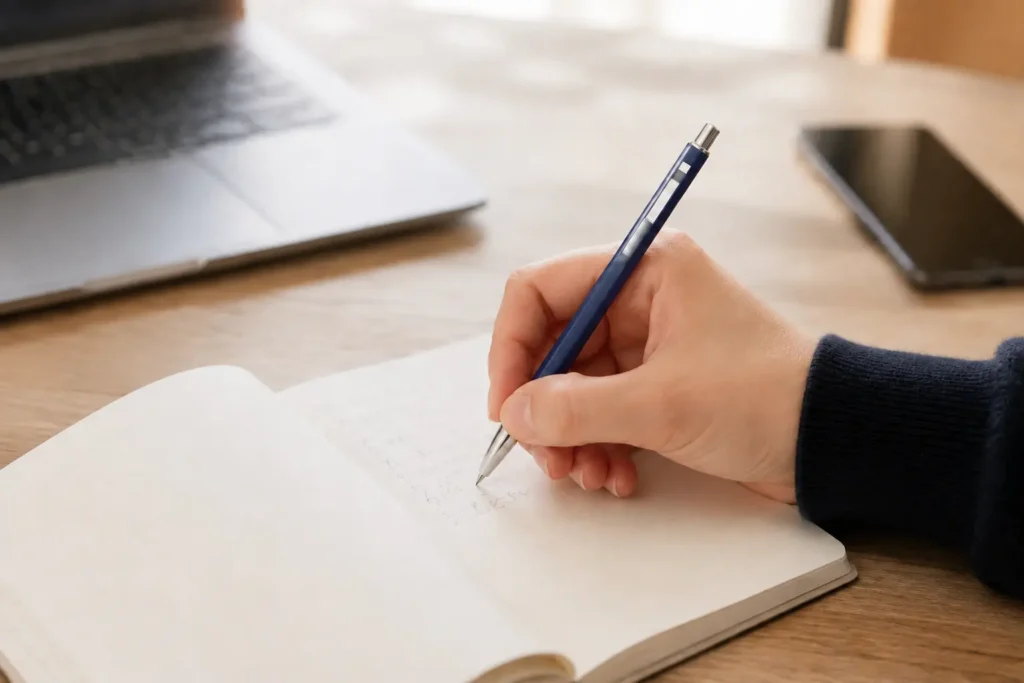
Its role is smaller and more human. Handwriting introduces a pause. A sentence takes time to form; a signature carries pressure; a short note preserves the movement of a particular hand. The physical act makes certain thoughts feel more deliberate.
Buying a 153 ID today is therefore not an attempt to escape the digital world. It is a choice to keep one tangible tool within it. The buyer remembers the past, but does not remain there. The same pen is used for a meeting happening now, an idea not yet developed, a message to someone else or a plan for the years ahead.
This is where the 153 ID becomes more than nostalgia. It allows memory to participate in the present and future.
Where Product Claims and Reviews Meet
The reviews do not overturn the product story; they define its limits. The metal construction and broad refill create the substantial, smooth experience praised by some owners, while producing the weight and line width that others may resist. The higher price is difficult to defend through writing performance alone. It becomes more coherent when the buyer also values the 153’s design lineage, the durability of a refillable body and the emotional clarity of giving a familiar Korean object as a gift.
The positive and negative signals therefore come from the same design decisions. That is why the 153 ID is not a universal recommendation—and why it can become unusually personal for the right owner.
✓
WHAT IT IS
The Monami 153 ID is a premium oil-based ballpoint that reworks the original 1963 Monami 153 in metal and matte colors.
Where the original was an inexpensive plastic pen that people used and replaced, the 153 ID keeps the familiar hexagonal form while adding a metal body and replaceable refill—turning a shared everyday object into one pen to keep.
It comes with a 1.0 mm point and accepts standard 1.0 mm and 0.7 mm metal refills. It sits between an ordinary office pen and a traditional luxury writing instrument: more substantial and durable than disposable stationery, but still familiar and easy to use.
×
WHAT IT ISN’T
It is not a new writing technology. It has no proprietary ink system or novel mechanism, and buyers focused only on technical writing performance can find many alternatives.
It is not a traditional luxury pen whose value depends on rare materials, handcraft or brand authority. Nor is it a commemorative replica made only for display; it is designed to remain in use.
It does not replace a smartphone or computer. It is an analog tool for the notes, signatures and plans that people still choose to leave by hand in a screen-centered age.
WHO IT SUITS
a strong choice for:
- someone interested in Korean industrial and everyday design;
- a person who remembers using the original 153 and wants that familiarity in a lasting form;
- a writer who enjoys a moderately weighted metal pen and a bold, smooth line;
- a visitor looking for a Korean object with a story deeper than a souvenir motif;
- or anyone choosing a practical, personal gift for a colleague, friend or family member.
THINK TWICE IF
You may be happier with another pen if: Results
-you want the lightest possible writing instrument;
-you strongly prefer an extra-fine line straight out of the box;
-you judge value only by writing performance per won;
In those cases, the original 153—or one of many excellent low-cost pens—may be the more honest choice.
Review method and limitations
K-SELECTIVE separates brand positioning, recurring consumer-review themes, retail signals, and editorial interpretation. The review-signal chart summarizes editorial coding of the available review sample and should not be read as a clinical measurement or a full statistical coding of every review.
K-SELECTIVE VERDICT
SELECTED — A KOREAN FRIEND
FOR WHAT COMES NEXT
The original 153 was Korea’s everyday pen, used by generations who studied, worked and built. The 153 ID turns that shared memory into one pen of your own—preserving the familiar form in metal while remaining ready for today’s notes and tomorrow’s plans. True to mon ami, it is a friend that remembers and writes on.
Product Information
PRODUCT
Monami 153 ID
RANGE
153 Premium Writing Instrument
CATEGORY
Oil-Based Ballpoint Pen / Stationery & Design
LAST CHECKED
5 August 2026
SOURCES
RELATED
- Insight — From 10 Steps to 3: What K-Beauty’s Routine Shift Reveals
- K-Signal — Sheet masks as routine-maintenance products
- Method — About / How We Select
Leave a Reply