
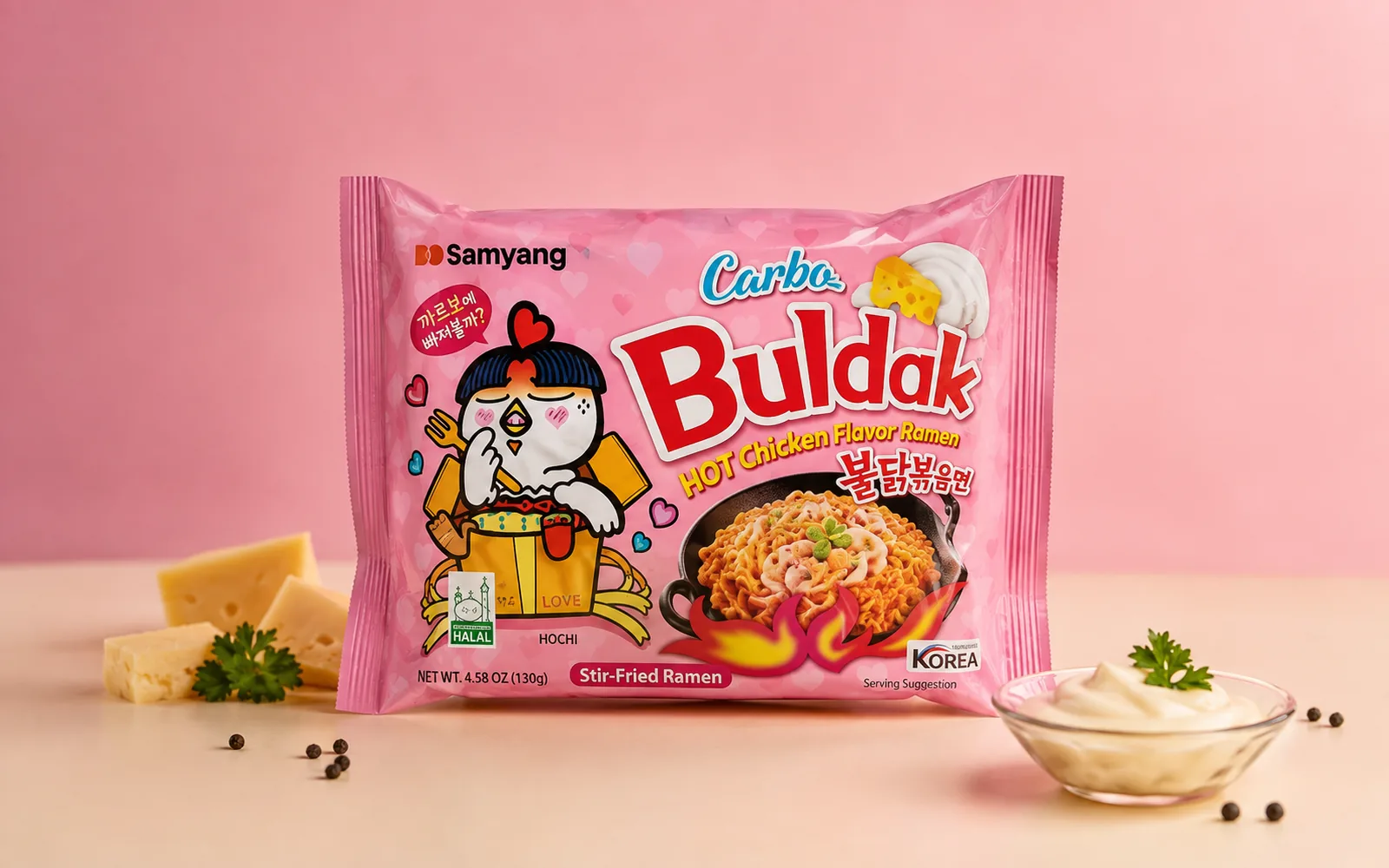
How a limited-edition Korean instant noodle became a global comfort food—and changed as it travelled.
Before Buldak Carbonara became a global comfort-food phenomenon, Korean consumers had already shaped it. Samyang developed the product after observing recipes that softened the original Buldak with creamy ingredients, then introduced it in Korea as a limited edition in December 2017.
The response turned a temporary experiment into a permanent product. After selling 36 million units during its three-month limited run, Buldak Carbonara returned in May 2018—and went on to become one of the clearest examples of a Korean consumer adaptation travelling globally without losing its original identity.
AT A GLANCE

BEST FOR
People who enjoy creamy, spicy noodles and like customizing them with egg, cheese or milk.

FLAVOR PROFILE
Sweet, creamy and savory at first, followed by the unmistakable heat of Buldak.

EXPERIENCE
Thick, chewy noodles with a glossy sauce that feels comforting, intense and easy to personalize.

CHOICE
A limited release sold 36 million units in three months and returned as a permanent product in May 2018.


Why This Product Matters
Some Korean products become global hits only after attracting attention overseas. Others arrive abroad with a history of domestic demand already behind them.
Buldak Carbonara belongs closer to the second group.
It is now one of the most visually recognizable Korean instant noodles abroad: a bright pink package, a cartoon chicken character and the promise of something both creamy and intensely spicy. Its international visibility can make it seem like a product designed primarily for overseas audiences or social-media challenges.
Its history, however, begins with Korean consumers modifying an existing product for themselves.
According to reporting on the product’s launch, Samyang developed Carbonara Buldak after observing consumer recipes that mixed the original spicy noodles with cream sauce. Samyang introduced it in South Korea in December 2017 as a limited edition commemorating one billion cumulative Buldak-brand sales. After selling 36 million units during its three-month limited run, it returned as a permanent product in May 2018.
That sequence matters.
Its role went beyond making a difficult product milder and easier to export. It emerged from a way consumers were already adjusting Buldak’s heat—and then proved strong enough in Korea to move from temporary release to permanent product.
Was It Actually Chosen in Korea?
This is the question that matters most to K-SELECTIVE.
A product can become highly visible through export distribution, influencer content or short-lived online challenges without necessarily becoming a sustained choice in its home market. In the case of Buldak Carbonara, the early domestic evidence is stronger than visibility alone.
The product began as a limited edition. It sold 36 million units in three months, and Samyang subsequently restored it as a regular product following continued consumer requests.
This does not tell us exactly who bought it, how frequently individual consumers repurchased it or whether it was equally popular across age groups. Public product-level consumer data remains limited.
It does, however, establish three useful points:
- The concept drew on consumer-led recipes already circulating in Korea.
- The limited release generated substantial initial demand.
- The response was strong enough to change the product’s status from temporary to permanent.

Why It Travelled So Well
Intensity defines the original Buldak experience. That intensity helped make the brand highly visible through reaction videos, eating challenges and social-media content.
Carbonara preserved enough of that intensity to remain recognizable while reducing the barrier to entry.
This created a useful middle ground. Consumers did not have to abandon the thrill or identity associated with Buldak, but they gained a creamier flavour, a more familiar comfort-food reference and more room for personal adjustment.
Its pink package also distinguished it immediately from both ordinary instant noodles and the darker, more aggressive packaging associated with the original Buldak. The appearance communicates playfulness and softness before consumers even prepare the noodles.
That combination made the product particularly suited to digital circulation:
- visibly identifiable packaging
- a strong reaction component
- an easy before-and-after cooking format
- enough flexibility for recipe experimentation
But Carbonara adds something the original challenge format cannot provide on its own: repeatable comfort.
People may try an extremely spicy noodle once for the reaction. A creamier version has a better chance of becoming something they return to, modify and incorporate into an ordinary meal.
How People Make It Their Own
In Korea, consumers can readily understand the product straight from the package: a familiar instant noodle variation that already balances Buldak sauce with a creamy seasoning. Consumers can therefore prepare it without many additions and still enjoy a complete dish.
Samyang’s official Buldak site also presents the noodles as a customizable base. It recommends milk, mayonnaise, egg, peanut butter and multiple cheeses to soften the heat and expand the flavour. Among these options, the brand specifically identifies its creamy egg preparation as a particularly good match for Buldak Carbonara.
These recommendations show how the brand frames Buldak as a flexible base; they do not replace independent evidence about how consumers actually prepare it.Outside Korea, publicly shared recipes frequently treat the package as a starting point rather than a finished formula.
Outside Korea, publicly shared recipes frequently treat the package as a starting point rather than a finished formula.
This does not prove that Korean consumers always eat it as-is or that overseas consumers always customize it. No sufficiently representative comparative dataset supports such a broad conclusion.
1. Egg and Extra Cheese
A fried or soft-boiled egg adds richness without fully diluting the sauce. Sliced cheese or mozzarella increases the creamy texture and makes the heat feel more gradual.
This is the simplest customization because it does not change the essential character of the product. It makes the existing flavour louder rather than taking it in a completely different direction.
2. Milk or Cream
Some recipes replace part of the cooking water with milk, evaporated milk or heavy cream. Cooks then add extra cheese to produce a thicker sauce.This version moves the noodles closer to a creamy pasta experience. It also reduces the immediate impact of the chilli, although the amount of liquid and sauce used can change the final intensity considerably.
This version moves the noodles closer to a creamy pasta experience. It also reduces the immediate impact of the chilli, although the amount of liquid and sauce used can change the final intensity considerably.
2. Milk or Cream
Some recipes replace part of the cooking water with milk, evaporated milk or heavy cream. Cooks then add extra cheese to produce a thicker sauce.
This version moves the noodles closer to a creamy pasta experience. It also reduces the immediate impact of the chilli, although the amount of liquid and sauce used can change the final intensity considerably.
3. Bacon, Egg and Black Pepper
Other adaptations lean into the word “carbonara” itself.
Bacon or another cured meat provides salt and texture, egg adds richness, and black pepper creates a visual and flavour reference to pasta carbonara.
This is the most culturally revealing version. Consumers reassemble the Korean instant noodle through an internationally familiar pasta vocabulary, even though the result remains far removed from a traditional Roman carbonara.

K-SELECTIVE Note
These examples represent recurring patterns observed in publicly shared recipes and videos. Readers should not interpret them as statistically representative of all Korean or overseas consumers.
K-SELECTIVE REVIEW ANALYSIS
Korean Consumer Review Analysis
The Coupang product page shows a large domestic review base for Buldak Carbonara, with 54,591 displayed reviews at the time of capture. For this first-pass analysis, K-SELECTIVE reviewed the latest visible written reviews shown in the editor-provided screenshot set and coded recurring product signals rather than the full review population.
◎
REVIEW SCOPE
54,591 displayed Coupang reviews · latest visible review screenshots analyzed · qualitative signal coding · Buldak Carbonara
| Experience Dimension | Repeated Positive | Repeated Friction | K-SELECTIVE Read |
|---|---|---|---|
| Taste balance | Consumers repeatedly describe the product as tasty, addictive and easier to enjoy than original Buldak because the creamy seasoning softens the edge of the sauce. | A smaller set of reviewers still note that the product can feel sweeter, richer or heavier than expected. | The central consumer response confirms the brand promise directionally: Carbonara softens Buldak, but it does not turn it into a mild cream noodle. |
| Heat level | Many reviewers treat the product as a more accessible entry point to the Buldak line and say they can enjoy it more easily than the original version. | Even in positive reviews, some still mention that it remains spicy enough to require caution, especially for low spice tolerance. | “Less spicy” and “mild” are not the same thing. Domestic consumers often frame the product as a more approachable Buldak, not as a non-spicy noodle. |
| Texture & satiety | Reviewers often praise the chewy noodle texture and describe the portion as satisfying enough for a full snack or light meal. | A few reviews imply that the final texture depends on preparation and additions rather than on the base product alone. | The noodle itself remains part of the product’s appeal. The experience is not only about flavour but also about a thicker, more satisfying eating experience. |
| Customization | Egg, cheese, milk and other additions appear repeatedly in the captured reviews and images, showing that consumers actively customize the product. | Customization can also signal that some users are trying to soften the heat or enrich the flavour beyond the base pack. | Consumers do not use the product only as a fixed instant noodle. They also use it as an adaptable convenience base. |
| Repeat purchase & household use | Many reviews describe repurchase, stocking up and family or household consumption, suggesting that the product has moved beyond one-time curiosity. | Practical complaints that do appear are more likely to concern price variation, damaged packaging or seller logistics than the product concept itself. | The strongest domestic signal is repetition: consumers buy it again, keep it at home and recommend it as a reliable favourite within the Buldak range. |
MOST REPEATED REVIEW SIGNALS
Signal indices are based on recurring patterns observed in the latest visible Coupang review screenshot sample analyzed by K-SELECTIVE. They indicate relative signal strength within the captured sample, not the statistical share of all 54,591 displayed reviews.
“Easier than original Buldak, creamy enough to enjoy more often, and worth buying again.”
— Coupang review
“It feels softer than the original, but it is still spicy enough to surprise low-tolerance eaters.”
— Coupang review

✓
WHAT IT IS
Buldak Carbonara is a dry-style instant noodle rather than a soup ramen. You boil the noodles, drain most of the water, and mix the liquid spicy sauce and carbonara-flavoured powder through them.
- the concentrated heat and chew of Buldak
- the creamy, cheesy expectation suggested by carbonara
Samyang describes the product as combining the smoothness associated with carbonara pasta with the signature heat of Buldak sauce.
That description is broadly accurate, but the balance is important. The creaminess softens the first impression of the spice; it does not remove the underlying Buldak character. Sweetness, dairy-style seasoning and heat arrive together rather than in clearly separated stages.
×
WHAT IT ISN’T
Despite its name, this is not an instant recreation of traditional Italian carbonara.
Classic carbonara generally combines pasta, eggs, hard cheese, cured pork and black pepper. Its creamy texture traditionally comes from emulsifying egg, cheese and pasta water—not from a powdered cream seasoning.
Buldak Carbonara uses “carbonara” more as a flavour signal than as a promise of culinary authenticity. It tells the consumer to expect richness, cheese-like creaminess and a softer contrast to the chilli sauce.
That distinction is not necessarily a weakness. The product succeeds because it does not attempt to reproduce carbonara faithfully. Instead, it translates the general idea of creamy pasta into the existing language of Korean spicy instant noodles.
Consumers should also not mistake it for a beginner-level mild ramen. “Less spicy than original Buldak” is not the same as objectively mild. For consumers with little tolerance for chilli heat, the cream-coloured powder and pink package may create a gentler expectation than the actual eating experience.

WHO IT SUITS
Buldak Carbonara is most suitable for:
- consumers who want to try Buldak without beginning with the original version
- people who enjoy sweet, creamy and spicy flavours together
- instant-noodle consumers who like adding their own ingredients
- overseas consumers looking for an accessible entry point into Korean spicy noodles
- existing Buldak fans who want a version that feels more like comfort food
THINK TWICE IF
People sensitive to capsaicin should avoid treating Buldak products as a spice-endurance challenge. In 2024, Danish authorities temporarily recalled three high-heat Buldak varieties over capsaicin concerns; Carbonara was not among those three products.
Review method and limitations
This article distinguishes among three forms of evidence:
Verified Product History
Release timing, limited-edition sales and conversion to a permanent product.
Brand Information
Official product positioning, flavour descriptions and recipe suggestions.
Observed Consumer Signals
Repeated ingredients and preparation patterns found in publicly available recipes and videos.
Publicly available data does not provide a representative statistical comparison between Korean and overseas preparation habits. We therefore present statements about customization as observed content patterns rather than conclusions about all consumers.
K-SELECTIVE VERDICT
SELECTED — CREAMY HEAT, MADE TO BE YOUR OWN
A Korean consumer-led variation that made Buldak more approachable without making it ordinary.
Buldak Carbonara keeps the core tension that defines the brand: comfort and heat in the same bowl. Korean consumers first softened the original noodles with creamy ingredients; Samyang turned that behaviour into a limited product, then made it permanent after strong domestic demand.
Overseas consumers extended the same logic with milk, cheese, eggs, bacon and black pepper. The product works best for people who want a creamy but still distinctly spicy introduction to Buldak and enjoy adapting instant noodles. It suits them less if they expect a genuinely mild noodle or an authentic Italian carbonara.
Product Information
Product
Buldak Carbonara
format
Stir-fried instant noodle · 130 g
CATEGORY
Korean Instant Noodles / Creamy-Spicy Ramen
korean Release
Limited edition: December 2017 · Permanent release: May 2018
best for
Creamy-spicy noodle fans · Customizable meals
LAST CHECKED
3 August 2026
Leave a Reply