

The 10-Step Routine Was More Than a Product List
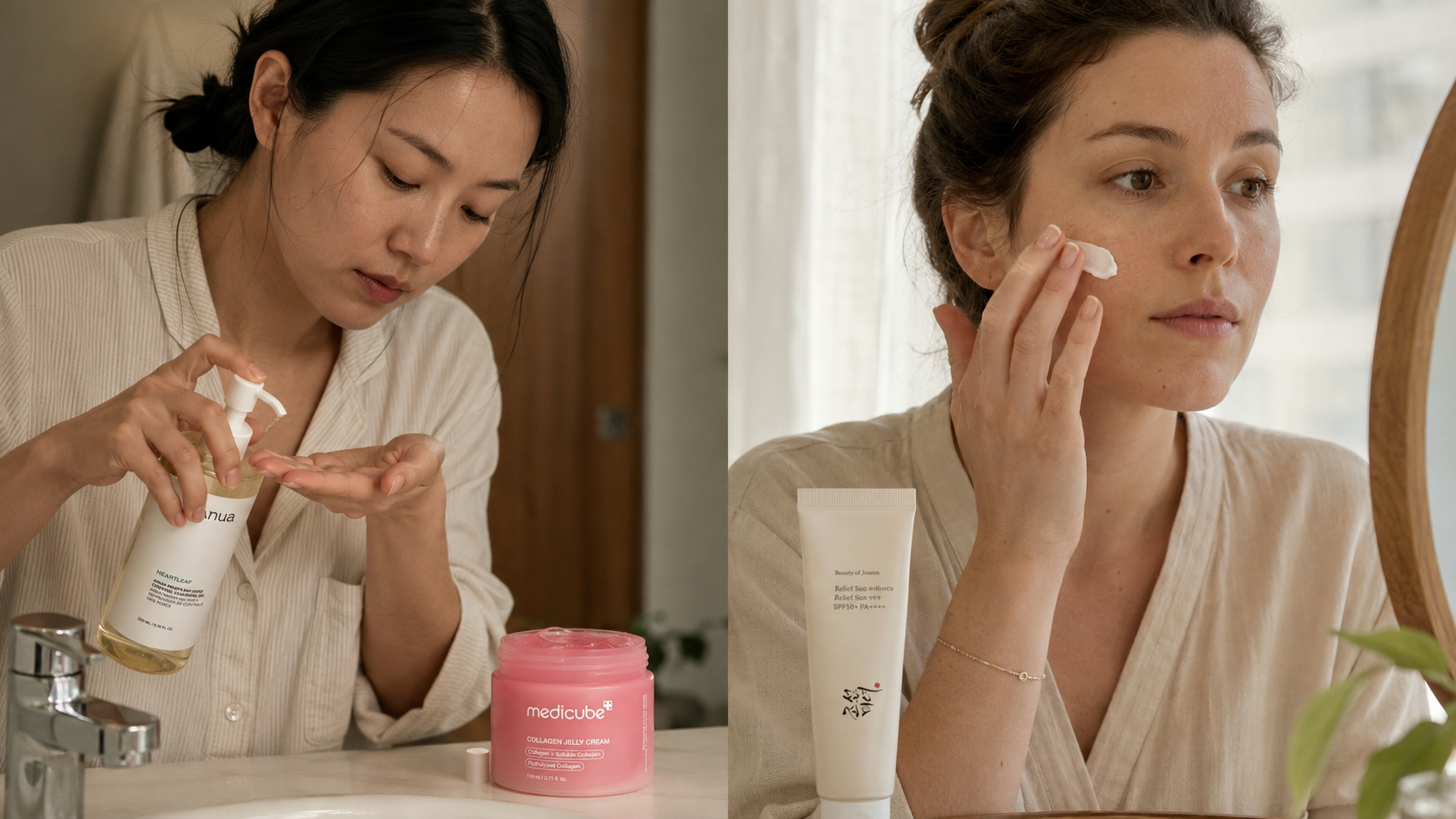
The global image of Korean skincare was shaped by cleansing oils, toners, essences, ampoules, masks, eye creams and moisturizers applied in sequence.
For consumers who were familiar with only a cleanser and one cream, this structure offered a new way to understand the skin.
Each product had a role. Texture determined order. Hydration could be built through several light layers rather than one heavy formula. Sunscreen became part of daily skincare instead of something reserved for summer or the beach.
This educational structure was one of K-beauty’s most important innovations.
The 10-step routine made unfamiliar categories easier to understand and gave consumers more control over how they combined products. It also provided brands with multiple points of entry into a single routine.
But the global version of the routine was often interpreted too literally.
Not every Korean consumer follows ten steps, and not every step was designed for daily use. Exfoliators and masks are occasional products, while sunscreen belongs to the morning routine. Eye cream and essence may be useful for some consumers and unnecessary for others.
The routine was always more flexible than its name suggested.

What Global Consumers Actually Kept
As K-beauty moved from trend to mainstream category, consumers did not adopt every step equally. They selected the formats that solved clear everyday problems.
Daily Sunscreen
Korean sunscreen helped change consumer expectations around texture. Instead of treating UV protection as a heavy seasonal product, Korean brands introduced lightweight formulas designed to sit comfortably under makeup and become part of an ordinary morning routine.
The lasting consumer value was not simply protection. It was habit compatibility.
Double Cleansing
Double cleansing gave consumers a practical explanation for using two different cleansers: an oil-based product to remove makeup and resistant sunscreen, followed by a water-based cleanser for the remaining residue. The method is not necessary for every person or every evening. But its clear functional logic has allowed it to travel across markets.
Toner Pads
Toner pads demonstrate a recurring strength of Korean product development: turning an existing step into a more convenient format. They combine product, applicator and dosage in one container. Depending on the formula, they can support hydration, soothing or exfoliation. The appeal is not a new skincare function. It is reduced friction.
Targeted Serums and Masks
Serums, ampoules and masks remain highly visible because they make ingredients and short-term skin goals easy to communicate.
PDRN, peptides, ceramides, cica and fermented ingredients can be presented through a focused product story rather than an entire product line.
Visually distinctive formats, including hydrogel masks that become transparent during use, have also performed well in social media environments where the application process is part of the content.

Why the Market Is Moving Toward Fewer Steps
K-beauty’s first global wave was shaped by discovery. Consumers were excited by unfamiliar formats, ingredients and packaging.
The next phase is more selective.
Consumers now have greater ingredient knowledge, more product choices and easier access to Korean brands. As the category becomes familiar, the question is changing from “What else can I add?” to “Which steps are worth keeping?”
Several factors are driving this change.
Time
A routine must fit into daily life. Products that require too many separate steps may generate initial curiosity but struggle to become repeat habits.
Skin Tolerance
More products do not automatically produce better results. The American Academy of Dermatology notes that combining too many products—particularly multiple active treatments—can cause irritation. Its practical baseline is much simpler: cleansing, moisturizing and sun protection.
Cost
K-beauty became globally competitive partly through accessible pricing. But using several affordable products can still create a costly routine. Consumers are increasingly evaluating total routine value rather than individual product price.
Decision Fatigue
As more brands launch similar serums, pads and creams, consumers need clearer reasons to choose one product over another. A long ingredient list or viral claim is no longer enough.
The result is skinimalism: fewer products selected with greater intention.
American Academy of Dermatology
The Consumer Signal: Control Over Complexity
The movement from ten steps to three does not mean consumers have rejected customization.
It means they want control over complexity.
A simple routine may begin with a cleanser, moisturizer and sunscreen. A consumer can then add one targeted product according to skin condition, season or personal concern.
This modular approach preserves what made K-beauty attractive in the first place—personalization, texture and experimentation—without requiring every consumer to purchase an entire system.
This is an important distinction.
The market is not moving from “complex” to “simple.” It is moving from fixed complexity to selective complexity.
Consumers still value choice. They simply want each choice to justify its place in the routine.
From Novelty to Repeatable Value
Korean cosmetics exports reached a record US$3.1 billion in the first quarter of 2026, up 19 percent from a year earlier, according to government data reported by Yonhap News Agency.
This growth suggests that K-beauty is no longer dependent on a single viral format or a temporary wave of cultural interest.
The category is increasingly being evaluated by the same standards as other mature beauty markets:
- Does the product solve a clear problem?
- Is the texture pleasant enough for regular use?
- Can consumers understand how it fits into their routine?
- Does the performance support repeat purchase?
- Is the product appropriate for different markets and regulations?
Vogue’s analysis of K-beauty’s latest global expansion similarly points to a shift away from novelty alone and toward ingredient-led products, accessible efficacy and wider retail distribution.
K-beauty’s future will depend less on how many steps it can introduce and more on how effectively it can help consumers choose.
What This Means for Korean Beauty Brands
The routine shift creates several opportunities.
Build Around a Clear Role
A product should be understandable within a few seconds. Consumers need to know whether it cleanses, hydrates, treats, seals or protects—and why it deserves a separate step.
Reduce Overlap
Launching multiple products with nearly identical functions may expand a product line but increase consumer confusion. Clear differentiation is becoming more important than the number of products offered.
Design for Habit
Texture, packaging, application time and compatibility with makeup can determine whether a product becomes part of daily life.
The product that performs best in a campaign is not always the one consumers continue to use.
Support Selective Personalization
Brands can offer different routes through a routine without insisting on one complete system. A basic routine with optional modules may feel more credible and accessible than a fixed multi-step set.
Replace Viral Claims With Evidence
Social media can generate discovery, but repeat purchase requires trust. Ingredient explanations, appropriate testing and realistic usage guidance will become more valuable as consumers grow more knowledgeable.

The Next Phase: From Routine Export to Decision Design
The 10-step routine will remain an important part of K-beauty’s global story. But its most lasting contribution may not be the number of products it introduced.
It taught consumers to think about skincare in layers, textures and specific functions. That knowledge has not disappeared as routines have become shorter. Instead, consumers are using it to make more selective decisions.
The next phase of K-beauty will therefore be shaped by brands that make expertise easier to use. Consumers still want visible results, enjoyable textures and room for personalization, but they also want fewer decisions and clearer reasons for every product they keep.
This is not a retreat from K-beauty’s original philosophy. It is evidence that the category is maturing—from exporting a routine to influencing how the world evaluates, selects and uses skincare.